


Support for Minimum Wage Boost Grows Stronger
With Los Angeles Mayor Eric Garcetti announcing support for $13.25 minimum wage, Inland Empire wages could possibly follow suit
By Corey Arvin, Staff Writer
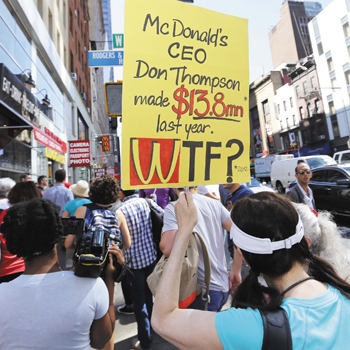
their supporters marched along 8th Ave calling for an increase in
the minimum wage.Some attempted to block the street leading
to several arrests. Photo: a katz / Shutterstock.com
Los Angeles joined a growing number of large metropolitans around the country last week that may invoke a series of increases in the state’s minimum wage – a controversial move in the ongoing debate over income equality. Experts say that following Mayor Eric Garcetti’s announcement Sept. 1, Los Angeles could serve as a model for other cities, potentially putting Inland Empire officials in line to follow and propose their own minimum wage increase.
Ellen Reese, Professor of Sociology and Chair of the Labor Studies Program at University of California, Riverside (UCR), says that many Inland Empire workers are currently making substandard wages – much less than the minimum necessary to support a family.
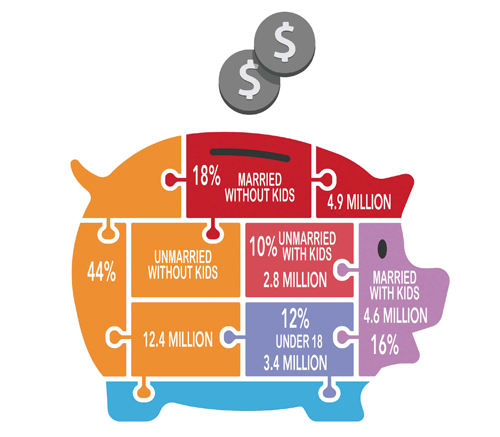
According to a U.S. Department of Agriculture report released last year, it would cost an estimated $241,080, about $13,400 per year, for a middle-income couple to support a child born in 2012 for 18 years. Reese said the notion of increasing the minimum wage is a fair proposal given that CEOs earn about 20-30 times more than the average low wage worker.
“I think we could use good jobs all over. Our local economy has really suffered, especially in the recession. Many people are still unemployed or under employed. … And not just any jobs, good jobs, good paying jobs,” said Reese.
“Raising the minimum wage would create a good wage floor and [other] wages would go up from that,” she added.
Garcetti’s proposal for Los Angeles, which would require support from the City Council, would call for a gradual increase of $1.50 each year in the minimum wage, with $10.25 in 2015, $11.75 in 2016, capping at $13.25 in 2017. Los Angeles’ proposed increase would be one of the highest minimum wage increases in the U.S.
“I think there is a definite political advantage. If you look at it, the workers that could benefit would be so grateful to the politicians, backing up their interests. The people who tend to oppose these increases are wealthy and have a short sighted vision,” said Reese.
However, for now, the Inland Empire may be too conservative to follow Los Angeles’ lead in increasing the minimum wage, says Catherine E. Levitt, PhD, adjunct professor at California State University of San Bernardino (CSUSB). In part, officials might hesitate because the Inland Empire, particularly San Bernardino County and the city, are still sensitive to economic recovery and the city is still dealing with the effects of its Chapter 11 Bankruptcy filing.
Business owners are also showing signs of skepticism in economic growth and hesitating to make any major expenditures, according to a recent study compiled by CSUSB’s Institute of Applied Research, said Levitt.
Levitt pointed to Santa Monica as a unique example of where minimum wage hikes have proven to be effective.
“Places where they have been successful like Santa Monica have extraordinary conditions. You have a lot of liberals there, but you have a lot of wealth as well. You can do that in Santa Monica. … The Inland Empire is very middle class at best,” said Levitt.
Pessimism in the economy is also reflected in corporations, which has an impact on job growth and wages, she said.
“They’re putting their money where they are going to make money and right now the place is the stock market and that’s because it’s giving a return of about 14 percent a year. If you put your money into people or a bank, you will see a small return from banks and chances are with people they can leave and are not going to be able to make products. … Large companies are sitting on tons and tons of money and cash is an idle asset until you invest it in something. If there was money in producing something they would but they see the stock market as more beneficial,” said Levitt.
Year over year, employment data has indicated that the Inland Empire is an important job market, statewide and nationally. In July, the Inland Empire, cited as “Riverside”, was named as one of the Top 10 cities for job growth in the nation. The report was compiled by Economic Modeling Specialists Intl. (EMSI), which included labor market data for the Riverside metro area and San Bernardino County. “Riverside” was 10th on the CareerBuilder’s list for adding 76,646 jobs from 2010 to 2013, buoyed by strong warehouse and storage industries, as well as medical offices and civil engineering construction.
Opponents have criticized various proposals to increase the minimum wage, suggesting it could hurt the economy and put stress on businesses, potentially leading to job losses.
“A lot of those fears are over blown. There are lots of well-paid lobbyists and advocates that don’t want to see a decrease in their high salaries and corporate executives. … I think [the impact] probably differs from business to business. There might be a slight increase in the price of things, but a penny more would go a long way in paying these workers,” said Reese.
Levitt stressed that education is key to more stability and better wages.
“You have to get an education. It’s the only thing that differentiates you from everyone else. It gives you skills and teaches to you to communicate. If you are just going general labor, anybody can replace, if someone is willing to come in for minimum wage,” she said.
The wages associated with new job growth have been criticized for being low-end compared to the wages of pre-recession jobs on record. In July, Larry Vaupel, Riverside’s Economic Development Manager said the “ripple effect” of residents having disposable income was a boon for the local economy, boosting sales tax revenue. However, the wages workers earned was something the city remains watchful of, he said.
“It is something we are concerned with. You don’t just want low wage jobs, but living wage jobs. This is something we are watching carefully.”
Low wage workers have demonstrated nationally, particularly in the fast food and quick service industry, calling for “living wages” – an outpouring that could be replicated in the Inland Empire, said Reese.
“I think it could happen. There are a lot of unions [here]…. I think what L.A. is doing is great and if [the proposal] goes through we need to wake up. Union organizers are supportive of this initiative… there is definitely a ground swell of support.”