


By Rory O’Sullivan
Many of the inland areas eligible votes won’t be counted in this year’s election on November 4th. It’s not because of voter fraud or discrimination or problems with polling machines, it’s because most voters don’t know enough about it.
Jaime Quintero, 43, of Corona knew there was an election, he just wasn’t exactly sure when.
“It’s November 2nd?” said Quintero. The 2014 election is actually Tuesday, November 4th.
Federal law dictates that Election Day falls on the first Tuesday following the first Monday in November.
Quintero was aware that elections fall on Tuesdays, but when asked what was on the ballot he only knew about Proposition 1, the $7.5 billion water-infrastructure bond measure, and Proposition 2, increasing the state’s rainy-day reserve, backed by Governor Jerry Brown.
“I don’t know anyone who’s on the ballot,” said Quintero.
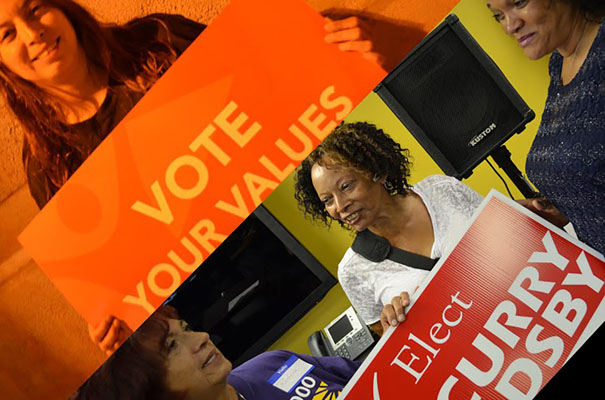
One of those on the ballot is Kim Curry-Goldsby who is running for Director of Western Municipal Water District; Division 2. Water board races generally see low voter turnout but with California in the middle of a historic drought one might assume this would be a draw for voter turnout.
Curry-Goldsby said most don’t even know there is a vote set for a water board seat. “They don’t even know what goes on at Western even though they are in the district,” said Curry-Goldsby.
According to Curry-Goldsby the board has the ability to affect water rates and sets the direction of water availability in the district. She spends most of her time letting voters know that there is an election for the seat.
Curry-Goldsby and community organizer Maribel Nunez have both had to fight against voter apathy. Nunez is supporting Proposition 47, which if passed, would reduce non-serious, non-violent crimes ranging from felonies to misdemeanors.
An informational Prop 47 meeting attended by one of the people who helped draft the bill had only about 20 people in attendance.
Leila Brown, 30, of Moreno Valley said she spends most of her time raising her three children. “I haven’t paid nearly enough attention,” she said. “Isn’t that awful I’m just not interested in it.”
University of California Riverside professor of political science, Shaun Bowler said local elections generally have lower voter turnout. He said with no president to vote for and an noncompetitive gubernatorial race, voter turnout is expected to be low.
“People don’t see the relevance of local politics the same as federal elections,” said Bowler. “Even though local elections can have a greater impact on our day to day lives.”
Both Curry-Goldsby and Nunez are working hard to get voters to the polls in November.
“I wake up at 5:00 AM most days,” said Nunez. “I believe it’s up to us to change it and increase the voter turnout.”
Nunez is doing presentations in high schools, walking house to house, and holding community outreach informational meetings like the one for Prop 47.
Through her efforts she has helped register more than a thousand people.
“I’m very optimistic,” said Nunez.
“I’m really encouraged,” said Curry-Goldsby.
Curry-Goldsby said her workload is “tremendous,” but she can see it all paying off come November.
“I’m on the phone I’m out and about if I go to the post office or bank or grocery store I’m handing my card out and letting people know what I’m going to do for them when I’m elected.”
Some voters take it upon themselves to be informed.
Monique Moraga, 46, of Riverside has followed who’s running and has made up her mind on how she will be voting. Moraga said her and her husband talk about the issues going on locally on a daily basis.
“I think it’s important to know what’s going on,” said Moraga.
Professor Bowler said most people don’t receive as much information about local races than national races because of the money it takes to inform the electorate.
Brown and Quintero both said they plan on voting in this election. Both also said they get the majority of their news from television.
Community organizations can help fill the gap in information.
Turnout estimates in Riverside and San Bernardino Counties for the June 3rd election were both below 20 percent. However, during a 20-day get out the vote campaign in the Palm Springs and Coachella Valley communities, turnout was significantly above the county average at 25.3 percent.
Bowler said voter turnout is largely based on what is on the ballot and how involved the community is.
“We do worry about turnout rates,” said Bowler. “Most of it is that it’s an off year and people don’t pay attention.”
What Bowler does see as a trend is more diverse candidates because of the changing demographics of California. Bowler said regardless of why, it’s a good thing to vote.
“You should vote, your vote is your voice.”