


By Corey Arvin, Staff Writer
Preliminary Ruling sets a controversial precedent that could threaten teachers’ tenure.
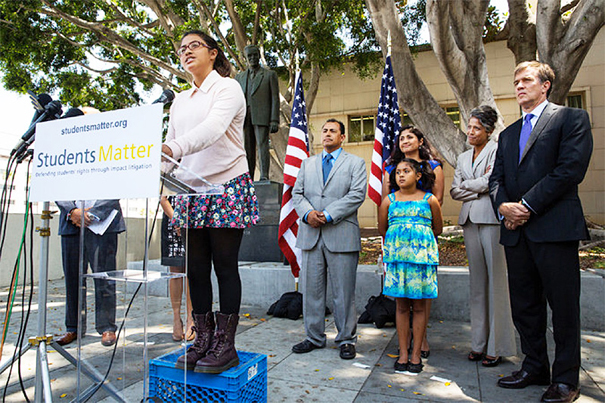
The debate on how teachers are hired, fired and rewarded swept across the U.S. from Los Angeles after a preliminary ruling was issued by the Superior Court in the Vergara V. State of California case on June 10. Nine students, backed by Students Matter, are challenging existing state statutes on teacher hiring and firing, and they believe the statues are unconstitutional, disproportionately affecting minority students. Reactions to the case have even come from top U.S. education officials who wonder what the implications might be if the ruling makes it past the state Supreme Court.
Superior Court Judge Rolf Treu stayed his verdict earlier this month allowing for appeals. The ruling has several more legal hurdles before it could reach the state Supreme Court, forcing California schools to comply, but the first verdict has left many teachers uneasy.
The fact the ruling favors Students Matters’ position is “disconcerting” and circumvents administrators’ abilities to work with teachers who may have performance issues, said Mikki Cichocki-Semo, Secretary and Treasurer for the California Teachers Association (CTA). The CTA is a 150-year-old organization that represents more than 325,000 members throughout the state, including teachers, counselors and librarians.
Cichocki-Semo, who lives in Riverside, is currently assigned to Youth Services for San Bernardino City Unified School District. Cichocki-Semo is a veteran educator who believes there are many hardships teachers face that are not always addressed or taken into account if they are accused of underperforming or ineffective. The preliminary ruling has reverberated among teachers, she said.

Mikki Cichocki-Semo
“Teaching is not an easy job. I love it and I wouldn’t have picked a different profession. I get to see it from a variety of standpoints, but teachers are tired of being beat up. They open up the newspaper and they are being beat up over and over again.”
Cichocki-Semo views the case as more complex than it is sometimes presented, but believes it is a divisive matter that is about more than protecting teachers. The CTA is currently waiting to file an appeal.
In part, the CTA website, says “Vergara v. State of California is a meritless lawsuit brought by Students Matter, an organization created by Silicon Valley multimillionaire David Welch and a private public relations firm for the sole purpose of filing this suit.”
“Simply put, this lawsuit highlights the wrong problems, proposes the wrong solutions, and follows the wrong process. This is yet another attempt by the usual corporate special interests to undermine the teaching profession and push their agenda on California public schools and students.”
According to Manny Rivera, a spokesman for Students Matter, the case is substantial for students because unlike teachers unions, students don’t have “millions and millions” of dollars to lobby and most cannot vote. Bringing a lawsuit against the state was the preferred route to address the issue of existing teacher tenure statutes in California because “the court is the place to make sure the rights of the minority are being protected.”

“This lawsuit essentially put the education system on trial,” said Rivera.
“Many of the schools in the district that are low-income have a higher concentration of ineffective teachers,” said Rivera. “We had expert witnesses [testify] that low-income students, Latino and African-American, have the higher percentage of ineffective teachers in the classroom,” he added.
Thomas J. Kane, PhD, a Professor of Education and Economics at the Harvard Graduate School of Education at Harvard University, was one of several expert witnesses who presented evidence in the trial supporting the plaintiffs. According to research, in Los Angeles Unified School District (LAUSD), African-American students are 43% more likely to be taught by a teacher that is in the bottom 5 percent of effectiveness, and Latinos were 68% more likely.
The group argued several statutes were unconstitutional. One area of contention was the “Last In, First Out” (LIFO) statute, which the plaintiffs argued retained ineffective senior teachers in favor of effective new teachers during layoffs.
According to Rivera, ineffective teachers in low-income school districts with high populations of minorities are more like to have ineffective teachers who bounce around from school to school.
“The case we put together was relevant and irrefutable. The facts are the facts,” said Rivera.
According to Cichocki-Semo, Vergara V. the State of California is another attempt to restructure teacher policies that would create more interference than benefit to students. Cichocki-Semo has been following the case and sharing information with teachers. She said public support for teachers in California has been strong in the past and hopes to retain that support for teachers.
“There are polls out there that have shown there is enormous public support for teachers. Everyone wants quality teachers for the students, I just think sometimes we disagree on how to do that,” she said.