


By Lee Ragin, Executive Editor
 CHSB President June Collison Discusses Life, Work, and Ethics
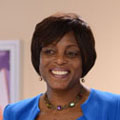
If you asked June Collison who she is, she’d tell you she was just like any other person. She goes to work everyday, has a family, loves on her grand boys, and enjoys traveling.
But those who know her closely know that Collison once was known as one of the fastest 400-meter runners and held a world record in the 400-meter race. Today, Collison may not be running circles around opponents on the track, but that warrior spirit has helped Collison excel in healthcare management and finance.
For years, Community Hospital of San Bernardino (CHSB) has fallen short of reaching their budget, consistently losing money; but since 2012, incoming President Collison has successfully worked on the struggling hospital’s profit margin, as well as changed the climate on the campus and the perception of Community Hospital in the community.
The hospital, a Dignity Health member, the fifth largest health system in the nation, is a full-service, not-for-profit community hospital housing 343 beds. Founded in 1910, the hospital employs more than 1,000 individuals and is an award winning hospital.
At CHSB, Collison is credited with bringing about a financial turnaround, fostering leadership on the CHSB campus by stressing the five core values for all Dignity Health hospitals including: Dignity, Collaboration, Justice, Stewardship, and Excellence. But according to Collison, the current growth at CHSB is not a singular effort but a collaborative company-wide undertaking.
IN HER WORDS
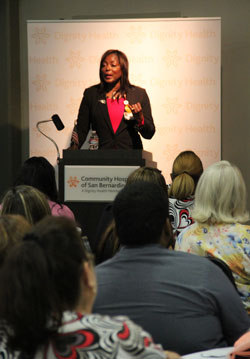
I am a grandparent’s baby. I grew up with my grandparents and anyone who has ever lived with their grandparents knows what I mean. It’s a different set up. They were old school. They would check you. I would know what I could do and what I could not do.
We come from a family of academics. I have aunts and uncles who are teachers and professors, who had their master’s degree. I grew up with that so education was very important in our household and I was always told by my aunts and grandparents that no one could take education away from you. It [education] was stressed in our family.
I had two career paths I wanted to do growing up as a child. I wanted to be an ambassador. I loved the glamour of it. I thought it was glamorous. And the other thing was being a missionary, helping the poor and helping the sick.
When I was in college at Adelphi University I had a very good friend in college at Florida State. Her major was hospital administration and my major was banking and money management. And I would always say to her, why are doing that? Work in a hospital? Why would you want to do that? Today, she is a businesswoman.
(Speaking on the difference from going from an athletic background to financial background) I got to tell you this, I’m a CFO by birth. I came up the ranks as a chief financial officer. For years I was a regional financial officer. And going through school, I felt if I had that finance background it would help me as a CFO to look at the big picture. So that transition wasn’t too difficult at all.
From an athletic background, when you do sports – you’re tenacious, you’re a warrior and I think that has translated into my work. I’m passionate I’m a fighter. Every problem has a solution.
When I ran track, I would walk to the starting line 400-meters and I would look at the other competitors and think someone is getting a whooping tonight. But that’s the warrior spirit that I believe all athletes have to have in order to compete.
I am one of those people that look at the glass half full. I’m not going to say my journey was peaches the whole time, where people would look at me and think I got that job because I was a track star. Don’t do that I am very skilled. I want people to see me for my competency and skill level. I had to overcome that factor because it was very troubling. I want them to see my expertise and skill level.
Today, I do the treadmill and I do pilates and enjoy every minute of my time.
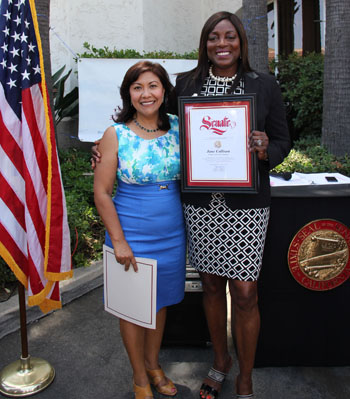
I think my role at CHSB is more of a visionary and we all work together; what I try to do is talk to the staff and get them to understand the core values of the organization. You must understand the core values and live the core values. I work with a strategic vision where we have to include the staff, physicians and everyone has to come together to understand where we are going. If you are a CEO of an organization and your staff does not know that vision, it’s going to be a long, long day.
It’s our job to make sure our patients come into our organization and they leave feeling and thinking this is the best experience they ever had. I also like to think I’m the cheerleader of the organization. The one that’s out there walking the talk; you’re not just telling the staff these are the expectations but you’re showing them and uplifting them holding them up while your doing it so that you have the same vision and take the same pathway.
It is going to be three years in February since I been here at CHSB. We have had a number of registered challenges. We were always listed by CMS so we had to work with a team to get a good quality person here and having the team understand patient quality and safety go hand in hand, so having the staff understand that was important to me. We do see ever so often the regulatory agencies but that’s when they need to be here and not have to be here.
When I came on we had not met our budget for quite a while. I’m happy to say that as of last year we have met our budget and exceeded it. I truly believe in the next year we will be doing even better.
THE LEAPFROG REPORT
In 1998 a group of large employers came together to discuss how they could work together to use the way they purchased healthcare to have an influence on its quality and affordability. They recognized that there was a dysfunction in the healthcare market place. Employers were spending billions of dollars on healthcare for their employees with no way of assessing its quality or comparing health care providers.
A 1999 report by the Institute of Medicine gave the Leapfrog founders an initial focus – reducing preventable medical mistakes. The report found that up to 98,000 Americans die every year from preventable medical errors made in hospitals alone. In fact, there are more deaths in hospitals each year from preventable medical mistakes than there are from vehicle accidents, breast cancer, and AIDS. The report actually recommended that large employers provide more market reinforcement for the quality and safety of health care. The founders realized that they could take ‘leaps’ forward with their employees, retirees and families by rewarding hospitals that implement significant improvements in quality and safety. Funding to set up Leapfrog came from the Business Roundtable (BRT) and The Leapfrog Group was officially launched in November 2000. Leapfrog is now supported by its members and others.
Based on public input and public output hospitals who contribute data for the Leapfrog Report are awarded a score of “A” through “F” and in 2014 CHSB was awarded an “A”. Over the last year CHSB has ranked the top 12 performers for patient satisfaction throughout the Dignity Health system which includes 39 facilities from California, Nevada and Arizona quality patient satisfaction is addressed.
I feel it is necessary for everyone employed to have a dialog with the President so they can see who I am, the expectations and the core values and why its important to live those core values. Collaboration is one of our core values.
I want CHSB to be their (the community’s) hospital of choice and we are going to be here, population health management, improving patient experience and health in the community. And I want to partner with clinics out there so we can do this together and improve the health in the community.
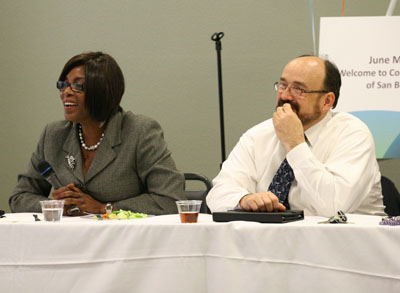
My life is an open book. I believe in transparency off the job and on the job but truly I am a proud grandmother of two baby boys. And they both are a year old and I love them to death.
The health field is one of the most beautiful fields to be in. Think about a nurse, you have a job for life. I always tell students set your goals. This is not a sprint it’s a journey. You are going to have some bumps along the way, but step back, pause, regroup and hit it again, go back to those goals but stay the course. Don’t say today you want to be an RN and tomorrow a physician, know what you want to be, set your goals, and reach them.
Also, treat everyone you come in contact with, with dignity and respect. That is so important. And when you get up there, when you climb that ladder and get up there, look back and bring someone with you. But most of all, stay the course, its not a sprint, it’s a journey.
In my spare time, I travel. I love to travel. I love Europe. I enjoy the architectural structures in London. Berlin, Turkey, those are the areas I love to go to.
This is what I want them to put on my tombstone: “She was fair.” Because I truly believe I’m a fair person.
I want to continue to foster leadership on campus through mentoring and coaching. One thing I do ask every new employee, you have to mentor the people below you; you have to coach them. In the interview process I ask the question, talk to me a little about your mentoring and coaching.
I am so passionate about my employees and my patients. If my employees are happy they will deliver exceptional care to my patients. I stress do not pre-judge anyone who walks through that door. Treat them as such – as if they were your mother, father, grandmother, grandfather, etc. Treat them as family.