


Riverside
On Tuesday, the UCR School of Public Policy presented “The Salton Sea and the New Normal: ‘A managed environment in the context of prolonged drought’.”
The seminar was presented by Michael Cohen, senior associate at the Pacific Institute in Oakland, California. The discussion brought needed attention to the plight of this ecologically vulnerable site.
Cohen has been a major Salton Sea advocate for more than 18 years. He is the lead author of three Pacific Institute reports on the Salton Sea, served on the Natural Resources Agency’s Salton Sea Advisory Committee from 2004 to 2007, and is a member of the Salton Sea Task Force’s Agency Stakeholder Committee.
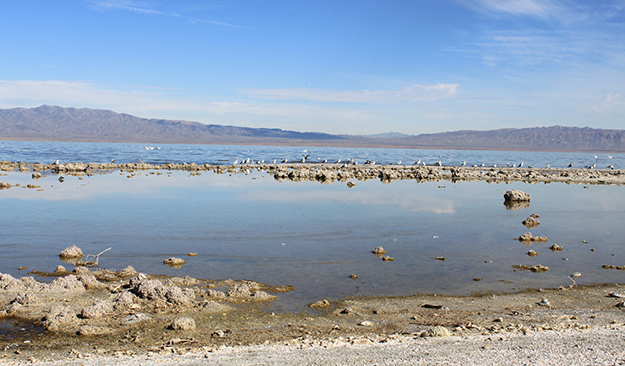
The Salton Sea, a crucial habitat for birds and wildlife, is approaching a tipping point. Once the playground of the rich and famous it now a murky, stinky wasteland where rotting fish wash ashore; and what was once a thriving beachfront is largely deserted.
The Salton Sea holds a unique place in California history. Sitting about 230 feet below sea level it was formed in 1905 when the Colorado River flooded through a diversion canal and refilled a former lakebed in the desert. Since then, irrigation water that flows through agricultural fields of the Imperial, Coachella, and Mexicali valleys drain into the lake. This is what sustains it and offsets loss from evaporation. Without the irrigation flows experts believe the lake would eventually shrink and ultimately disappear. This process however, results in a concentration of salts and other contaminants carried by the river and from the fields themselves to the lake. Not surprisingly, the Salton Sea is 50 percent saltier than the ocean and yet it supports more than 420 different species of resident and migratory birds.
Despite the lake’s current grim condition there is renewed hope for a brighter future. In 2014, California voters approved a significant water bond measure with some money that may be directed toward mitigation measures for the lake. In 2015 a position was created to oversee policy for the lake; and late last year it was reported that decision makers are gradually moving toward consensus over short-term and future projects aimed a mitigating ecological challenges at the site.