



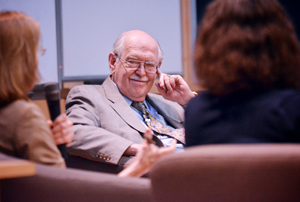
Photo by Carlos Puma
Peter McPherson speaks at UC Riverside with faculty members Jodie Holt and Sharon Walker.
By Kris Lovekin
Peter McPherson, the president of the Association of Public and Land-grant Universities (APLU), said 80 percent of the children of the richest families in America earn college degrees, while only 10 percent of the children of the poorest families do.
That inequity is a real problem for the nation, and it is a problem being tackled by the large public research universities, McPherson said during a symposium Friday, May 30 at UC Riverside. He said members of the APLU teach 64 percent of the college students in the U.S.
“UC Riverside, by itself, serves more students eligible for Pell grants than all of the Ivy League put together,” said McPherson, a leading voice in America on the needs of public higher education. Federal Pell grants go to low-income students. He said he was impressed by UC Riverside’s success in graduating students from all walks of life at the same rate. “I hope you know how unusual that is,” he said.
He lauded the campus for including 55 percent of its undergraduates in the research process.
“He is a humble man and a true personal friend,” said UC Riverside Chancellor Kim Wilcox as he introduced McPherson as the third and final speaker in the 2014 Chancellor’s Symposia on the Future of the American Research University. He listed McPherson’s varied career, from the Peace Corps, to special assistant to President Gerald Ford; head of USAID; Deputy Secretary of the Treasury Department; president of Michigan State University and Chairman of Dow Jones.
Since government is decreasing spending for public universities, creativity will be key in lowering the cost of college, McPherson told an audience of about 150 people, mostly UCR faculty and administrators. Technology, including online classes, will help. “We know that online classes can produce learning,” he said. And we know that technology is getting better, but we don’t have the scale yet.”
He also pointed out the need for a more streamlined approach to advising and tracking student success. “With all that we know about learning, we have no reason NOT to be applying it.” He said public research universities need to do a better job of convincing the federal government to compensate the universities for all the research that contributes to innovation and economic growth.