


By Samuel Williams, Jr.
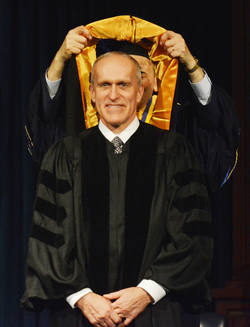
Newly appointed University of California Riverside (UCR) Chancellor Kim A. Wilcox said he couldn’t have asked for a more ideal situation to walk into when appointed to the position by the University of California Board of Regents on August 8, 2013. Wilcox succeeds former Chancellor Timothy White, who left the post in late 2012 to become president of the California State University system. Last week, Wilcox was invested as the 9th Chancellor of UCR.
“I am fortunate to walk into a situation where a former chancellor left the university in such good shape,” Wilcox said. “I have some really big shoes to fill because not only was Chancellor White a great leader, but he is beloved on this campus. I have the pleasure of simply building on the foundation he laid over the past years.”
Wilcox said his primary goal is to bring UCR into national prominence. He is excited about one aspect that should help that cause.
“UCR is one of the few universities in the country where the graduation rate of African American students exceeds that of Caucasian graduates,’ Wilcox said. “I have also put in place meetings with members of the national press to let them know how great the academic growth is here on our campus.” Wilcox also said UCR is unique in the fact it is a school where the core of the student body are young people relying on Pell Grants.
“It is uncommon to have such a demographic thrive because the overall demographic nationwide indicates these students not likely to get into college let alone succeed at such high rates,” Wilcox said. “That says a lot about the faculty here and the dedication and attention shown to their students. I want to use this success, let it be known on a national level, and have UCR referenced to as a model for other universities to emulate.”
It is the cohesive and collaborative relationship between the City of Riverside and UCR that really drew Wilcox to the school.
“What really was appealing to me was the great relationship between the city and Chancellor White and the ease I am finding in maintaining that same level of cooperation,” Wilcox said. “I have to give the city high marks because they worked tirelessly to ease the strain with the increasingly large number of students moving into the area. It created a situation where the city had to make adjustments like making legislation to deal with issues like noise, parking and they actually made changes in zoning ordinances to accommodate the university. They even increased police patrols to ensure the safety of our students. It is rare to find a city willing to work hand-in-hand with a collegiate entity.”
Wilcox steps into his role at a time of great expansion on the UCR campus. The school has announced the opening of its new medical school, the creation of a new school of public policy, expanding research opportunities and the potential to broaden the campus’s international reach.
Building the schools faculty is another priority for Wilcox. “The student body is growing faster than our faculty,” Wilcox said. “I really want to broaden and enrich our research programs. If we can put ourselves in position where our students are not only learning but creating as well in the research areas, that should bring in more research money and help create more capital stimulus to the local economy.”
Wilcox is excited about plans to build new residence halls around the campus. According to Wilcox, the school has 22,000 students but anticipate the student population will expand to 25,000 students by 2020.
As provost of Michigan State from 2005 to July 2013, Wilcox had oversight responsibilities for more than 200 academic programs, nearly 49,000 students and almost 5,000 faculty and academic staff. During that time, he implemented major institutional restructuring and strategic positioning initiatives, and helped lead a capital campaign that raised $1.4 billion. He added 100 new faculty positions, expanded the university’s two medical colleges and created the Residential College in the Arts and Humanities and the College of Music. Previously, he was dean of the College of Liberal Arts and Sciences at the University of Kansas, from 2002 to 2005, and president and chief executive officer of the Kansas Board of Regents from 1999 to 2002.