



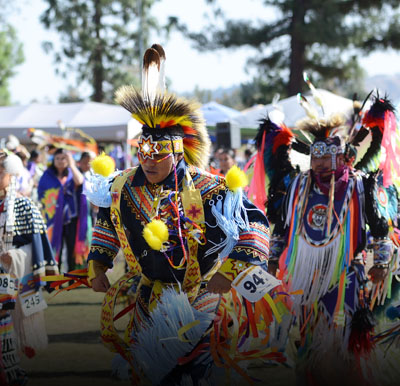
 Approximately 800 Native American dancers, singers, drummers and artisans participated in the San Manuel Band of Mission Indians’ 19th Annual Pow Wow at California State University, San Bernardino.
“Pow Wow” the traditional phrase for a Native American tribal peace gathering or for a meeting where warring tribes could meet to negotiate.
Approximately 800 Native American tribal members from Montana to the Dakotas and Alaska to Canada, dancers, singers, drummers and artisans from throughout North America traveled to San Bernardino this past weekend to celebrate Native American culture at the San Manuel Band of Mission Indians’ 19th Annual Pow Wow at California State University, San Bernardino (CSUSB).
The annual event honors music, competitive dance, crafts and food, but in addition, the Pow Wow offered a unique patchwork of Native American traditions.
“The Pow Wow ensures that tribal cultures are not lost,” stated one attendee.
The weekend-long event, which was free and open to the public, attracted approximately 15,000 attendees who enjoyed competitive dancing and drumming performances by men, women and children of all ages.
Tom Ramos, brother of former tribal chairman James Ramos, works with other tribal members to coordinate the huge event.
“The San Manuel Band of Mission Indians is honored to bring together members of tribes from throughout North America and members of our community,” said Ramos. “By coming together each year, not only do we celebrate and share our cultural traditions with each other, but we help keep our traditions alive by passing them on from generation to generation, and sharing them from tribe to tribe.”
The San Manuel Band of Mission Indians have been hosting their annual Pow Wow to not only educate Native Americans of their history, but the entire community.
San Manuel Band of Mission Indians History
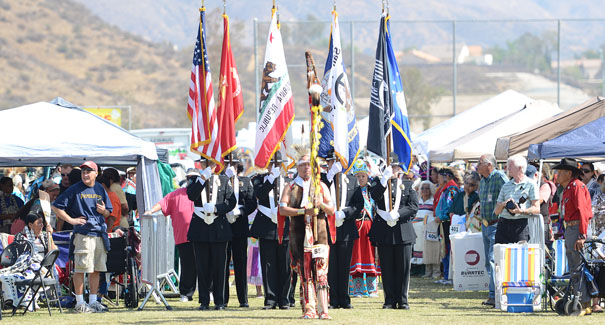
The San Manuel Honor Guard helped kick off opening ceremonies at the 19th Annual Pow Wow October 10.
The homelands of the San Manuel Band of Mission Indians has shaped their culture, traditions and present lives. The people at the San Manuel reservation are the indigenous people of the San Bernardino highlands, passes, valleys, and mountains who the Spaniards collectively called the Serrano, a term meaning highlander. The Serrano looked to nature and the land to provide the necessities of life including shelter, clothing, food and plants used for medicine. The Serrano people embraced the pine forests and flowing water of the high country. Their creation story tells of the first people who tended to their creator Kruktat as he laid ill and dying high in the mountains. When the creator died, the people began to mourn and in their grief turned into pine trees. The nuts and acorns scattered by these trees became food for the Serrano clans who would follow these first people. Those Serrano who lived at Yuhaviat, an area of pine trees near present day Big Bear Lake where the creator died, were called the Yuhaviatam or the People of the Pines. Members of the San Manuel Band of Mission Indians are the Yuhaviatam clan, and like their ancestors, they maintain a special connection to the land.
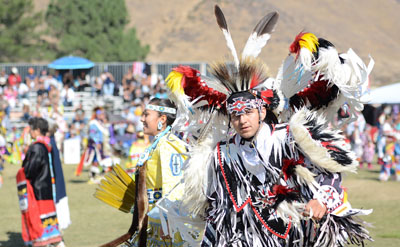
In addition to competitive performances, the Pow Wow featured non-competitive intertribal dancing and exhibitions including Bird Singing and Dancing, which is Native American music indigenous to Southern California and the Colorado River region.
Singing has always played an integral role in the lives of the Serrano people. Unlike other American Indian musicians, traditional Serrano musicians do not use drums for rhythm but instead they fashion gourd rattles with palm tree seeds inside to make percussive sounds. In the past, songs of the Serrano people were used to prepare for hunting the bighorn sheep roaming their ancestral land. These songs reminded hunters that if the natural systems were in order, the sheep would be there and they would not come home empty-handed. The San Manuel Band of Serrano Mission Indians has been successful in preserving many of these songs. To this day, songs are sung to describe social customs, creation stories and history of the region’s indigenous people. In recent times, elders from the neighboring Cahuilla tribe have taught bird songs to tribal members at the San Manuel reservation. Bird songs are sung throughout the Southern California area as well as the Mohave Desert and along the Colorado River. Bird songs are not directly about birds; rather the songs derive their name from the migration of birds that parallel the movement of people through their territory, telling the story of the creation, animals seen along the way, and sacred places.
The crowd joined in on the fun as well, with prizes awarded in a spectator dance contest.