


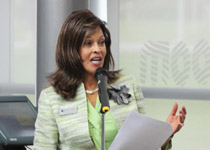
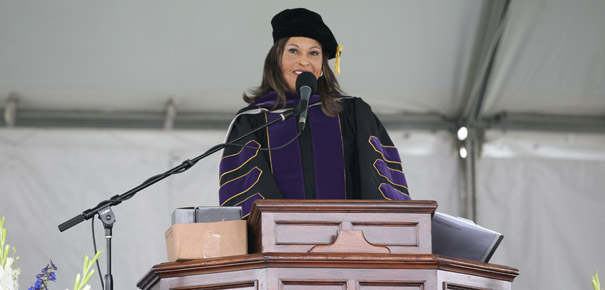
San Bernardino Valley College Interim President Dr. Gloria Fisher developed a love for education at an early age and went from teaching the neighborhood children on her block as a child, to overseeing the day-to-day operations at one of San Bernardino counties fastest growing community colleges.
The Voice recently spoke to Dr. Fisher on her early life, her family, and her thoughts on education.
What was life like growing up as a child?
I was born and grew up in San Francisco with a wonderful mom and dad who were always there for me. I have a younger brother and he and I remain very close. My mom was a college graduate and a nurse. My dad was a ship fitter. We did everything together. Anytime my parents went somewhere, they took us with them. Later, our family moved to Riverside and I have been in this area most of the time since, except for a few years when I went to law school in Fresno and worked for a law firm there.
Was education stressed in your family?
Very much so. The push at home was to be educated. My dad’s philosophy was you go to school, get educated, then go to work. The whole idea of life was to have a job. It’s what you do.
As a child, what did you see yourself doing when you grew up? And how different is it from your current career path?
When I was very young, I thought I wanted to be a stewardess—today of course, that would be “cabin attendant.” The idea of working and traveling just seemed like a great idea to me. But even as early as middle school I knew I wanted to be a teacher instead. There was a large family on our block that had this ramshackle old one-room building in the back of their property, and I used to teach school to the family’s children there. They were all younger than I was and this was not playtime, it was serious learning. Their parents were immigrants who did not speak English, so they were not exposed to things we native English speakers take for granted. I taught them the ABCs, colors, how to count. I took it very seriously and they did too.
I want to give credit to one of my own teachers from that time, Ms. Rohan, who was from Ireland. She had a tremendous passion for teaching, and in those days we had one teacher for all our subjects. She added something special to our curriculum, and that was learning all about Ireland. She clearly wanted us to know about her home, and her enthusiasm really resonated with me. Her greatest satisfaction seemed to come from the success of her students, and I have never forgotten that.
Prior to coming to SBVC, what did you do?
When I started college, which by the way was right here at Valley, I had an idea in mind that I wanted to be the next Perry Mason. Criminal law was exciting to me. In addition to course work here at Valley, I also took classes at RCC and then at Cal State San Bernardino. I also started teaching around that time for the Riverside County Office of Education.
Then I was accepted to San Joaquin College of Law in Fresno, where I graduated fourth in my class. I went to work for a law firm there doing all civil work and was their contracts specialist. My Perry Mason criminal law dream had to be put on hold.
When my mother took ill, I returned to Southern California. Once I was back home, so to speak, I started thinking about my love of teaching. I ended up returning to the classroom at the community college level, first with Riverside City College, at what were then satellite programs, not full-fledged campuses, in Moreno Valley and Norco.
With my JD degree and law firm experience I taught law at both schools, including courses in real property, civil proceedings, legal writing, contracts, and business law.
How did your career begin at SBVC?
While I was teaching at Rio Hondo in 1991 I found out about and applied for a full-time, tenure-track position that had opened at San Bernardino Valley College. The position was for an instructor in the college’s Administration of Justice program. When the college hired me, it was a bit of a dream come true, combining my two loves—teaching and criminal justice.
I have been with Valley College now for some 23 years, and I cannot imagine being anywhere else.
What are some of your biggest accomplishments at SBVC?
In 1994, after three years of teaching, I was appointed Co-director of the San Bernardino County Sheriff’s Department law enforcement training programs, which included the Basic Academy, Reserve Officer training, and Advanced Officer training. My new assignment also included the role of Director of the Extended Format Basic Law Enforcement Academy Program offered on the SBVC campus. I was now the Department Chair of our Police Science Program.
The regular sheriff’s academy is an intense, 23-week-long program whose students are almost all people who already have been provisionally hired by a law enforcement agency, conditional upon satisfactory completion of their academy training.
But not everyone who wants a career in law enforcement can just quit everything else they are doing to enter such an intense program. Some people still have full-time jobs and families to support. That’s why the Extended Academy was started. These students do the same courses and training, but it’s spread out over a year, with five-hour classes two nights a week and one weekend day from 8 a.m. to 5 p.m.
Then, in 2000, the college underwent reorganization and I was selected to become Dean of Criminal Justice. This gave me responsibility for the sheriff’s academies, our administration of justice degree and certificate programs, and our corrections certificate program. As an additional assignment I was involved in the start-up of the Middle College High School that now stands right across the street from our college. This program lets students who qualify, earn an associate’s degree from Valley College while they also complete their requirements for their high school diploma. I am very pleased that I was able to play a role in establishing that school.
Next, I was asked to become acting Dean of Social Sciences, followed by my appointment as the Supervisor of the San Bernardino Community College District Police Department. Along the way, I also was in charge of the Perkins Grants for the college.
In January 2012 I was named the Title IX Coordinator and just four short months later I took over as Interim Vice President of Student Services, a position I held until being asked to serve as Interim President starting in April 2013. It’s been a whirlwind the past few years, but I am proud of the fact that as we come out of the Great Recession our enrollment is growing, our campus continues with its bond-funded construction programs, and our graduates are transferring in greater numbers to four-year schools or starting careers in various trades and vocations that are in growing demand.
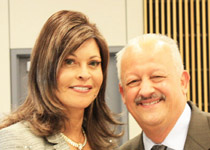
Dr. Fisher with Dr. Tomas Morales, President of Cal State University, San Bernardino during an event honoring SBVCs Middle College High School outstanding students.
Where do you see SBVC in the future?
My vision is that San Bernardino Valley College is embraced by our community because the education of our students is at the center of everything we do. Whether it’s basic skills or an AA or AS degree program, training to stay current in one’s job or learning a whole new skill for a changing workplace, Valley College is the place that people come to for their educational needs.
I also see our college as a growing community resource where people also come to hear concerts, watch theatrical productions, and enjoy being part of a vibrant community asset where they always feel welcome, where they love to come and be part of what’s going on.
As our building program approaches its latter stages, I also see a campus that becomes environmentally responsible with drought-tolerant plantings that sacrifice nothing for beauty and ambience.
How would you like to be remembered?
That is a hard question to answer. It is not something I spend time thinking about. I suppose, taking a page from how I was brought up, I would like to be remembered as a person who treated people fairly and respectfully. I would like to be thought of as someone who maintained a sense of balance and integrity. Frankly, if it’s wrong, I won’t do it!
What are your plans for outreach to incoming students?
We have a very well developed outreach program to attract new students. Our outreach specialist regularly visits our feeder high schools. We sponsor on-campus events for high school counselors to let them know about our various degree and certificate programs, as well as the wide variety of student services we offer, including programs for those with special needs.
These include tutoring programs, supplemental instruction, disabled student programs and services, a program that allows high school students to earn college credits while still in high school, as well as non-college credit courses for those who need more work on their math and English.
We have courses in English as a Second Language, an office dedicated to veterans’ needs, a program that fosters STEM studies—that’s science, technology, engineering, and mathematics—a foster and kinship program for both youth and their caregivers…it’s a really comprehensive list.
We even send our counselors out to area high schools to do pre-enrollment assessments at the high schools, to be more convenient for the students.
I personally regularly meet and visit with the superintendents of our feeder high schools to cement our partnerships as we discuss our many shared interests.
How do you foster leadership on campus?
We have regular training programs for our managers. In fact we just held an all-day managers’ retreat on June 26th. I encourage our managers to enroll in off-campus leadership programs and I am enrolled in one myself. There is a lot of benefit in being exposed to the experiences of seasoned community college leaders who have been there and done that, who understand the particular challenges of community colleges, as opposed to more generic types of training.
To that end, the Association of California Community College Administrators provides a good deal of help to community college executives, and we take advantage of their offerings.
What advice would you give to students today regarding their aspirations, career path, education, etc.?
The first thing I would say is that you have to be committed. Set a goal and commit yourself to accomplishing it, including setting yourself targets for both the short and the long term. And then, most important, never give up!
In your spare time, what do you enjoy doing?
(Laughs). Spare time, you say? Well, actually, I made a commitment to myself that I would purposely set aside time for myself. So one thing I like to do is read, and I usually enjoy both fiction and non-fiction, although lately I have taken to reading a couple books about community colleges.
From time to time I manage to get out to play a round of golf. And my guilty pleasure is going to Disneyland. I think that stems from my childhood and my grandmother when we lived in Northern California. She once took me to Disneyland not long after it first opened and that experience just completely engaged me. I always took my son and later my niece and nephew as well when they were younger. Now I go twice a year and always enjoy it.
Finally, tell us a little about your family life.
I’m single and I have a grown son, six grandchildren—one girl and five boys, and three great grandchildren—one girl and two boys. I also have three Yorkshire terriers.