


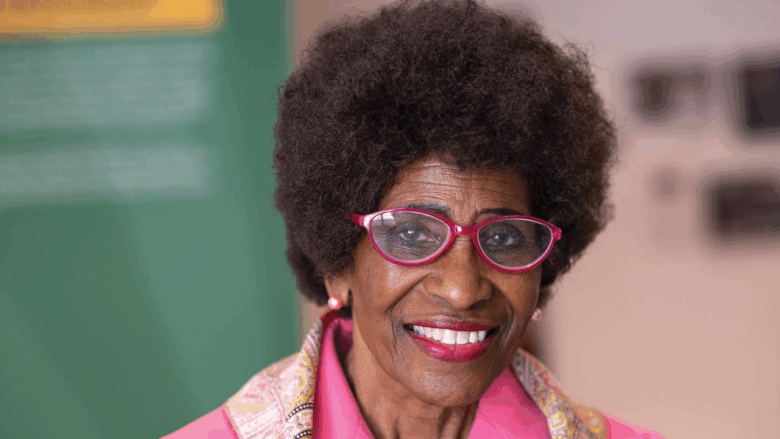
Aryana Noroozi
Black Voice News sat down with Rose Mayes, director of the Riverside County Fair Housing Council to reflect on the legacy of Dr. Martin Luther King Jr. Mayes is also an advocate for civil rights and celebrated community leader. She reflected on the civil rights history across the Inland Empire and the nation, and emphasized the importance of commemorating Dr. Martin Luther King Jr. In addition, Mayes addressed the ongoing challenges in civil rights’ discussions and the significance of Dr. King’s legacy in society today.
Check out the interview below!
This article has been edited for clarity.
BVN: What impact do you hope for the 29th Annual Martin Luther King Jr. Walk-A-Thon to have within the community?
Rose Mayes: It’s my desire and my hope that we will have a successful 29th Annual Walk-A-Thon and continue to bring people together for the betterment of the community. There’s nothing like people working together, playing together and just getting along together; that’s the only way we’ll be able to keep Dr. Martin Luther King’s hope for each and every community alive.
I would like to see the young people, along with the seniors, professionals and non-professionals, give us the hope that we can accomplish this by doing things like the walk-a-thon. Working together and talking with one another about what we can do together should be ongoing, not just on Martin Luther King (MLK) Day, but every day. I think that’s what Dr. King would love to see us do. I would like to thank all of the high school students who have taken an interest in MLK Day this year. Not only are they coming, they’re bringing their parents along. Those are things that I like to see within the community.
BVN: What do you enjoy doing this month, or even year round, to commemorate Dr. King?
Rose Mayes: I enjoy the roundtable discussions regarding some of the issues on civil rights. To me, it’s very important that we discuss the various points of view and various issues that we are actually experiencing within not only our homes, but our workforce and in the community as a whole, such as diversity, equity and inclusion. We need to continue to discuss the same issues that we’ve discussed before because they’re coming back. We might as well just be for real about it and start talking about it, rather than running away from it and pretending that it’s not happening within our workplace, within our community, within our churches, and even within our personal lives.
BVN: What are some of Dr. King’s work and legacy that you feel is most prevalent today?
Rose Mayes: I’m very thankful that in 1964, the Civil Rights Act was coupled with the Federal Housing Act, and how it became more powerful because without the Civil Rights Act of 1964, we would not have had any enforcement. We would have just been going through the motions of counseling people about what their rights and responsibilities were under the Fair Housing laws, but because of the Civil Rights Act, signed into law by President Lyndon Johnson, we now have those particular rights with some enforcement power behind them.
We just didn’t stop with housing. We went on to fight for fairness in education and fair employment. And now even in housing, we see that we have to go the extra mile because we thought we had it all covered through laws preventing discrimination [in] renting or purchasing. Now we’ve got to look at the appraisal part of the process, where when people go to a certain zip code, they find there is still discrimination in housing appraisals. What we need to do, is to start educating ourselves in every facet of our lives, and educating the next generation. We have to constantly come to the table and talk about it and make sure that everyone is aware of it: you can be discriminated against in any area of your life, even health or technology. Let’s just be realistic, think about it, talk about it.
BVN: Can you speak to Civil Rights achievements in the IE that readers should be aware of and celebrate?
Rose Mayes: I’m very proud of the fact that both San Bernardino and Riverside Counties work together. First, with the short range goals here in Riverside County, in the naming of Dr. Martin Luther King Street. We could not find anything but one item that was named after Dr. Martin Luther King back in the ‘70s, and ‘80s, and that was actually in the Riverside Community College District where there was a building named after Dr. King. But we continued on and we started seeking, trying to have a street named after King, and that happened.
Also, there was not a room in the Riverside Unified School District named after anybody of color. So we submitted for a school in the Woodcrest area to be named after Dr. Martin Luther King Jr. There was a big fight over that. There were many, many ugly things said. However, we were able to succeed in getting that done in a predominantly white community.
This year, we are doing celebrations all the way from having a walk-a-thon to having church discussion groups to having workshops. You name it. It’s our time to make sure that we educate the young people on what they need to do to carry on King’s legacy. We [must] remember that there are some people who lost their lives behind making sure that we have a right to do the things that we can do today and not to take it for granted.
BVN: Are there any final words or thoughts you’d like to add?
Rose Mayes: With the way information is provided through social media and other technology, I think that we will be getting mixed messages even more now. I would like for young people to take a look at that and know their sources, and know exactly what they’re reading. They should make sure that they know how to do the research. Whatever you do, don’t take anything for granted, and do your homework so that you can prepare yourself to start passing the message on by educating the young people who come behind you, so that you will know the truth. Because as they say, the truth will always set you free.