


By Corey Arvin,
Staff Writer
 Patricia Arquette’s Oscar speech raises questions about why women lag male counterparts in wages.
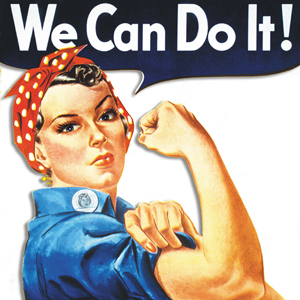
I’ve never seen an image more iconic and telling of the evolution of women’s role in society than the “We Can Do It!” poster created by Howard J. Miller in 1943. As husbands and fathers defended the U.S. during wartime, women were left to fill traditional male-designated roles. This poster, which features a character called “Rosie the Riveter”, was symbolic of female empowerment for many women in the U.S. and beyond. It’s hard not to be awestruck by the poster as the woman stares back with piercing eyes, a steel smile, brimming with confidence because there no task she can’t overcome. But for all the things women like her could accomplish on their own 70 years ago, today, tough ladies of that bravado haven’t earned a fair share for their efforts. In fact, these absolute and determined women are stifled, using their brawn to chip away at a glass ceiling while too many men sit back and idly watch.
Increasingly, entertainment awards season means recipients will dig deep and give recognition to a social cause, without or without relationship to their award. Last month, Patricia Arquette’s Oscar speech could have been simply noted and filed away — there are arguably many pressing issues concerning women. Arquette commanded a moment and urged, “It’s our time to have wage equality once and for all, and equal rights for women in the United States of America.” The industry was abuzz after her speech because the timing of her remarks comes during a period when we are all checking ourselves to ask if we are giving women enough respect. The news stories about domestic and sexual violence against women have been pervasive since last year. To correct these unfortunate tragedies, it really starts with confronting the core issues. The answer is more than simply “don’t harm women”, it begins with respecting women on fundamental levels. If we walk backwards from the moment when a woman is struck, before she is violated, or verbally berated, it all began with a lack of respect and parity. We have shaped a society today that directly and indirectly says that allowing a “Mad Men” culture of relegating women is, to some degree, acceptable.
That has to change.
On March 2, President Obama and First Lady Michelle Obama hit the nail on the head as they introduced a new global initiative to bolster education of girls and young women who have little or no access to education. (We’re not even talking about quality education here, just an education). The initiative is aimed at helping girls overcome “barriers, large and small.” During his speech, Obama got it right: “Even today, in some parts of the world, girls are valued more for their bodies than their minds”. It’s true in developing nations, and to some degree, it is a persistent reality for girls and women in America.
President Obama has been on to this for quite a while, long before his March 2 announcement or his unforgettable speech about violence against women during this year’s Grammy Awards. The first bill he enacted was the Lilly Ledbetter Fair Pay Act of 2009, to help address unfair wage gaps between women and men. How much progress is being made since the enactment is still in question.
The disparities and discrimination women endure in the workplace are quite real, distressing and staggering to say the least. In a report titled “The Gender Wage Gap: 2013”, data indicated that the ratio of a woman’s weekly full-time earnings compared to a man’s was 82.1 percent. The report, which was published by the Institute for Women and Research Policy, also showed those previous wages were just one percent lower in 2012. Some sections of academia may have issues as well. A UC campus study released this year found that women and ethnic minority faculty earned a little less than in salaries than the non-minority males.
And for those women worried about how their appearance impacts their careers, there may be something to think about. A different study conducted by Jennifer Bennett Shinall, a professor at Vanderbilt Law School, in part, showed that the more a woman weighed, the smaller the chances she would work in a job that involved personal interaction. Yet, there was no difference among obese men in any field.
As a man, I cannot relate to some of the pressures that a woman has to consider in the workplace, like “Was my demeanor too tough during my evaluation?”, “Will I still have a job after my maternity leave?”, “Can I still make partner if I get married?”. For as many women as there are working in male-dominated industries, there are a slew of women in industries perpetuated as “female oriented”. The only women in my life gravitated towards professions where there was a strong support system of fellow women — my mother was a nurse and my sister a social worker. But did they dare to dream they could thrive elsewhere if they chose a different path? It’s hard to avoid these questions because we, as men, have fostered and cultivated this type of environment — and it impacts all of us, our families, our daughters, and our sisters.
No woman is a second-class citizen — and it’s only a matter of time before the “We Can Do It!” women of the world prove that point.