


Riverside
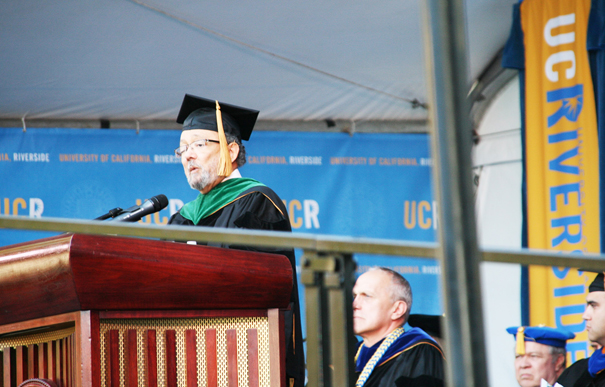
–”Failing to prepare for the accelerating speed of innovation is preparing to fail.” That was the message Inland physician and longtime I.E. Voice health columnist Dr. Ernest C. Levister Jr. gave approximately some 500 graduates at the University of California, Riverside’s Bourns College of Engineering (BCOE) commencement ceremony on Monday, June 16.
“Your future as engineers is in a dynamic constantly changing and evolving world. Ever shorter product development cycles from bench to manufacturing floor or bedside will drive society’s economic growth at a dizzying pace,” said Levister, a chemical engineer.
He said those involved with technology will need to be multidisciplinary; as social, cultural, political and economic forces utilize and impact technology.
Levister used a ‘toolbox’ metaphor to prepare the graduates for what he described as ‘today’s profit driven corporate and technology culture.
Navigating the unknown requires developing the right tools among them, sound business and analytical skills, lifelong learning, strong professional networks and unwavering integrity.
He urged graduates to be open to change or prepare to sit on the wrong side of history.
“In 1899 Charles H. Duell, Commissioner, U.S. Patents boldly declared, ‘Everything that can be invented has been invented’.”
“Fast forward, doctors are using nano-sensors to diagnose disease, nano robots for surgery, regenerative medicine and tissue engineering. Nano particles cross the blood brain barrier mapping the brain’s wiring.
He told graduates some tech visionaries predict with rapid advancements in 3-D printing, someday doctors will print customized limb replacements layer by layer in the operating room.
Drawing on stories and real-life experiences growing up in a Harlem, New York low rent project, Levister said strong parenting and family friends like civil rights activist, educator and author W.E.B. DuBois equipped him with the necessary moral compass and critical tools needed to weather the affects of crime and drug infested neighborhoods, violent street gangs, segregated classrooms and ostracized workplaces.
“In the 1950s a mere one half of one percent of the engineers in America was Black. I had no engineering role models, networking and group study was virtually nonexistent.”
Despite those barriers Levister was among the first in the nation to graduate from a 3-2 dual degree engineering program. Last month he celebrated his 50-year reunion from medical school.
Levister said according to UCR statistics seventy percent of BCOE grads have jobs within six months of graduation but he warned of the dangers that lurk in today’s wealth driven technology environment.
“In the 50’s growing up in drug and crime infested neighborhoods the principles of amassing wealth, power and instant gratification ruled the day,” said Levister, adding many of those same principles rule in today’s profit hungry corporate and technology cultures.
“The ravishes of the crime and drug trade share a similar scenario to the fall of Lehman Brothers, Enron and the 2001 dot.com bust. Principles of street gang turf wars once synonymous with dark alley deal making are now played out in lavish corporate boardrooms and partisan courtrooms. How will you set your moral compass,” Levister asked the graduates.
In closing he told the BCOE Class of 2014 it is a mistake to think that college commencement means education finished.
“The word commencement means beginning,” said Levister. “Go out and break some eggs, make a mess, fall down, get up regroup, and create a better world.”