


By Rory O’Sullivan
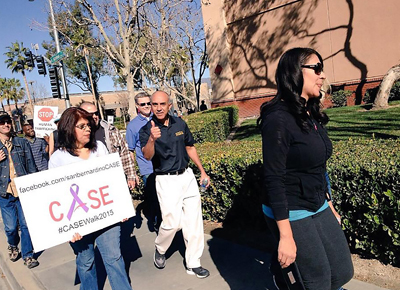
San Bernardino County District Attorney Mike Ramos joined activists and community leaders at a recent awareness walk organized by San Bernardino’s Coalition Against Sexual Exploitation.
It’s Friday night… Late night. Angie Andrews and her team are getting ready to go out, just like they have done for nearly two years. She just wants to pull at least one girl off the street, change one of their lives for the better.
Human Trafficking is one of the world’s richest trades at an estimated $32 billion a year across the globe, while most think it’s limited to impoverished third world countries, it has become Riverside and San Bernardino counties fastest growing criminal enterprise.
Andrews, a concerned civic leader however, sees these women, with hips swaying back and forth to the rhythm of the night, in cutoff tattered jean shorts, maybe a skirt, sometimes in heels sometimes not, showing enough cleavage to entice a potential client but not enough to draw a cop’s leer passing by.
“Most of them are young girls,” Andrews estimates most are between the ages of 15 and 25 but she has seen some as young as 12. “They’re just babies.”
Individuals who are trafficked usually are runaways, foster children, or have few employment options.
Atty. Gen. Kamala Harris’ office has defined human trafficking as modern-day slavery. The vast majority of those trafficked are women and girls used for sexual exploitation with over half being black or brown.
In the two years between July 1, 2010 and June 30, 2012, California’s task forces initiated 2,552 investigations, identified 1,277 victims of human trafficking, and arrested 1,798 individuals according to the Attorney General’s office.
Human trafficking comes in three forms, sex trafficking, labor trafficking and domestic servitude. The crime generally goes unnoticed to those who are not a part of that lifestyle.
Opal Singleton, president of Million Kids and Training and Outreach Coordinator for the Riverside County Sheriff Anti Human Trafficking Task Force, said the fight against human trafficking needs more people like Andrews because of the task forces limited resources.
“Any kid in a tough spot can get trafficked,” said Singleton. “They can’t survive on their own and then they end up getting trafficked.”
Andrews does what she can for them. She gives them gift bags filled with cosmetics, a small Bible, and emergency numbers including her own.
Andrews wants to do more. She and Singleton both agree that there is a need for more homes where women may be safe from their abusers and receive the counseling and medical attention needed after being on the streets.
Andrews plans to open a home for victims of human trafficking later this year.
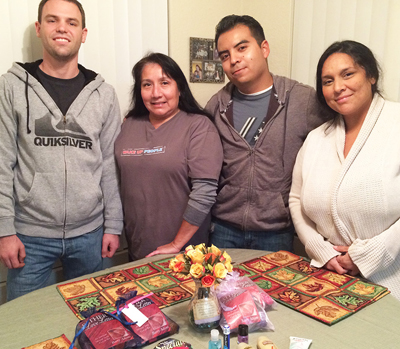
Angie Andrews (middle) founder of, The Repairer Of Broken Walls, stands with her outreach team before heading out to rescue teenage girls off the streets.
Singleton said the state has made real progress in the prosecution of traffickers. Recent changes including the passage of Proposition 35 have increased the mandatory sentencing for convicted traffickers and gives victims who turn on their abusers immunity from prosecution.
Law enforcement is still having a difficult time obtaining convictions. There are only nine task forces in California and Riverside County’s task force has less than ten officers.
“The cases are difficult to convict because law enforcement doesn’t have the resources to catch these crimes as they happen,” according to Singleton, “and getting victims to testify against their trafficker is difficult.”
“They’ve been betrayed by adults, pimps, parents and caregivers. They can’t trust adults, and the detectives have to develop a rapport with them, which is not easy,” she continued.
Singleton said more enforcement is necessary, especially online, where children may be recruited and then “groomed” without their parent’s knowledge.
“I want to warn parents of the persistence of children who can meet dozens of strangers online every day,” said Singleton. “There is a generation who’ve only known the internet and parents and grandparents who have no idea how to use it.”
She warns parents to be aware of which social media their children are using, including many popular video games that allow users to communicate one on one with each other.
“We had one girl who was recruited from her Wii U,” said Singleton.
Terry Boykins, chief navigation officer at Street Positive, who mentors young women and men said parents need to communicate with their children about the dangers that are out there. He said most traffickers look like every day people to reduce attention and to attract the girls.
“If you’re looking for someone in a canary yellow suit and purple gators you won’t find him,” said Boykins.
He agrees with Singleton that more and more traffickers are becoming technologically savvy. The amounts of money they’re making is bringing more sophisticated traffickers.
“They’re making moves with nothing more than a smartphone,” said Boykins.
Boykins said he has spoken to women who can make up to $100,000 a year for her traffickers. He said it pays for traffickers to know where they can get new recruits.
Andrews said the key is to let the women and girls in that life know there is a way out and that they are loved.
“Sometimes that’s all they need is someone to pray with them,” said Andrews.
She remembers praying for one woman who called her three months later to say she is no longer having sex for money.
“That’s why I do it,” said Andrews. “That’s what keeps me going.”
Andrews has rescued many more than she can count. She has been threatened by traffickers and warned by police officers of the inherent danger in her work, she won’t stop, because, “there’s one more girl out there who needs saving.”
Breaking Teen Trafficking
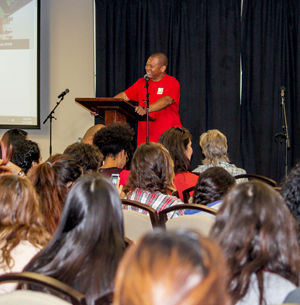
Last month over 250 attendees attended BREAK Teen Trafficking at Cal Baptist University to gain both information and resources about the impact of sex trafficking in the Inland Empire.
The community collaboration was planned by Women Wonder Writers (Debra Postil and Kailin Scott), Big Brothers Big Sisters (Jennifer O’Farrell) and Street Positive (Terry Boykins). Cal Baptist University and the School of Sociology and Forensic Psychology (Marilyn Moore) hosted the event.
With more than twelve workshops to choose from, attendees were also treated to a live performance written by King High School’s Drama department. Additionally, a keynote address on life in the streets was presented by sex trafficking survivor Ms. Cody Foute.
One of the more compelling workshops, Parents vs. Pimp$: The Ugly Truth, was conducted by Street Positive CEO, Terry Boykins. Workshop participants were provided with key terms used in sex trafficking and by pimps; teen sex trafficking is estimated at $9.5B in the U.S. alone. Boykins also challenged parents attending the workshop to confront the significant amount of child maltreatment present among victims.
The event also featured community resources and key contacts for those looking for survivor support.
Women Wonder Writers has worked directly with survivors for a number of years. And, serves high “at-risk” youth offenders through its mentoring program supported by the Riverside County District Attorney’s office.