



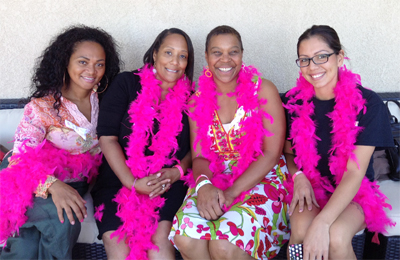
As the Sales and Special Projects Manager for Adams Motorsports Park, Timel is responsible for as she puts it, “a little bit of everything”, sales, marketing, staffing, and event set-up. And while juggling her career, family, and friends, she had been harboring a secret from many within the community. In December 2012, Timel was diagnosed with breast cancer, accounting for her short-cropped hairstyle, a sign of her treatment from chemotherapy. Timel, along with many women who are diagnosed with breast cancer, has learned to persevere and survive.
“People need to know to react right away,” says Timel who underwent surgery on February 6, 2013. “I started chemo right away in March and will be doing this for one year and three months.”
Timel’s story is not unlike many other women. She had her annual mammogram in October of 2012, and that “just knowing your body helps. Really, my husband felt a lump underneath my breast that moved around like a marble. He told me you better get that checked out. When I went to the doctor, he thought it was a cyst because it was moving. Well the doctor ordered an x-ray and biopsy and when he looked on the computer he was shocked and said it was stage 2 cancer.”
“My grandmother passed away from breast cancer but my mom never had it. It skipped a generation,” she says.
She stresses the importance of women knowing their bodies and not letting fear stop them from getting checked or even being afraid of the treatment for breast cancer. “Chemo is totally different than it used to be as far as the infusions, medications and things you go through. I did lose a little hair but before it got too bad, I cut it all off.”
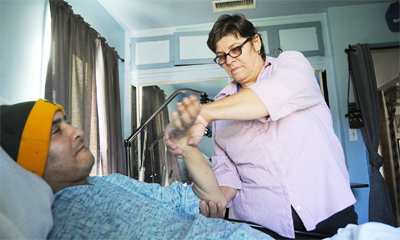
According to the American Cancer Society, an estimated 22,850 new cases of invasive breast cancer are expected to occur among women in California in 2013.
Being diagnosed with breast cancer does not mean a death sentence.
“The American Cancer Society encourages all women to put their health first. We want women to understand the benefits of eating a balanced diet, maintaining a healthy weight, exercising regularly and limiting alcohol intake,” said John Morgan, Dr.PH, epidemiologist with the California Cancer Registry, professor at Loma Linda University, and longtime volunteer for the American Cancer Society. “Breast cancer patients and their caregivers can turn to us for free support and information any time of the day or night. It’s because of quality support, early detection and improved treatment that more than 2.9 million breast cancer survivors across the nation will celebrate a birthday this year.”
Much like Timel, San Bernardino resident Cynthia Gatson has annual mammograms and check ups, and everything changed five-years ago. She was shocked to learn from her physician that they had found a lump in her left breast.
“Fortunately, they caught it early,” Cynthia admits. “But in August of 2008, I had to have my left breast removed and not even six months later, they found a lump in my throat and removed my thyroid.”
“I was scared, very scared. I’ve never been a sick person,” she says. I have always been the strong one of the family. I was very scared. I go every year and get my mammogram and never expected to hear that. Never felt any lump or anything. It was a shock. But they believe they got everything.”
After hearing the diagnosis Flowers admits, “I didn’t let my son know. I think maybe I let my sisters know. My cancer was ductal carcinoma in-situ, which means it wouldn’t spread right away. But they caught it early.”
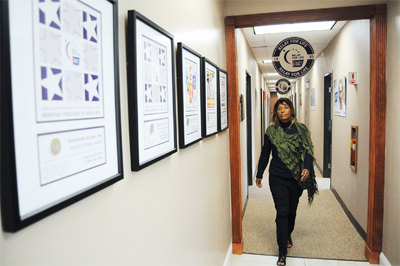
Unlike the others, Marlene had options for surgery because her form of cancer was a tumor. She underwent surgery in January 2013 the week of her birthday. The results were okay but the margins of the cancer cells the physicians felt were too close to other tissue. The doctors were concerned that the cancerous cells may be heading into more tissue with the risk to spread.
She underwent a second surgery in February and the results showed that the cancerous cells did not spread. The physicians had gotten all the cancer. After the second surgery, radiation treatments followed.
“I didn’t need chemo because it didn’t spread,” says Marlene. “I had radiation for five weeks and it went well. I had some side affects with it and they put me on anti-cancer medication which I will start next weekend.” Marlene later learned that the removed cancer cells tested positive for estrogen. The receptors in her breast were also positive for estrogen which doctors believe may be the factor that created the cancer. “I will be taking estrogen blockers. Which stops the fat cells from producing estrogen and I won’t form any more tumors, I had wonderful doctors at Kaiser.”
Currently Marlene is cancer free but says that it’s just not the physical aspect of cancer most patients deal with. It’s the emotional aspect of being diagnosed, going through treatment and surviving cancer.
“Cancer also goes on emotionally,” she says. “Physically, they may take out the tumor but emotionally you’re still impacted because you’re concerned it will come back. I attend cancer groups at Kaiser, a monthly women’s support group. It still affects you emotionally for years to come. I don’t fear that word cancer anymore. I used to refer to it as the Big “C” but I don’t anymore. It’s given me the desire or passion to help others. If I could speak to someone and say the right thing to encourage and comfort, I can tell her. I’ve taken that path before.”
“There are two types of patients of cancer — cancer patients and cancer survivors. I want others to be encouraged and let them know there is hope for them to deal with their bodies. It involves lifestyle. For me, I have to stay away from the pesticides, herbicides, and fertilizers. I want to go as organic as I can.“
Marlene does not see cancer as the death sentence as she first thought. She has become active with the American Cancer Society and even helps with the monthly women’s support groups at Kaiser in Fontana.
“Because cancer was a reality to me, I joined the American Cancer Society Legislative Ambassadors. We advocate to Congress, Washington and Sacramento and we encourage them to pass certain bills for the study of cancer, pass bills for additional health benefits for women.And we advocate for women’s health overall,” says Marlene.
And much like Timel and Cynthia who serve as women of faith, strength, courage and survival, Marlene says, “I live with the faith that the Lord is going to give me a long life. I’m no worse off than the next person without cancer.”