


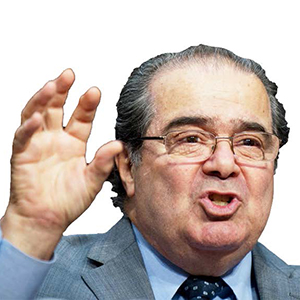
Supreme Court Justice Antonin Scalia
As the future of Affirmative Action hung in the balance before the United States Supreme Court last week, Americans were stunned by what many perceived were racially disgusting remarks spoken by Supreme Court Justice Antonin Scalia during oral argument in the case of Fisher vs. University of Texas-Austin.
Although Scalia has long been recognized for his far right philosophy, this time many African American lawmakers believe he went beyond the pale of acceptable judicial decorum in a case that has the potential to impact the lives of Blacks and other minority students.
The case in question was brought against the University of Texas-Austin by plaintiff, Abigail Fisher, for the institution’s use of Affirmative Action in its admissions’ policies. In the case, Fisher a white woman, claimed she was discriminated against because of her race; and, argued the university accepted non-white students whose grades were worse and who she claimed, had fewer extracurricular activities than she had.
In the past, the Supreme Court has ruled colleges can include race as a factor in admissions’ decisions. For example, in a 2003 Supreme Court ruling (Grutter vs Bollinger) the court held the University of Michigan Law School could use race as part of what the court identified as a holistic approach to admissions. However, much has changed since 2003.
The Court is now more weighted with conservative justices and that balance may foretell an outcome that could end Affirmative Action in school admissions—an outcome feared more certain in light of Scalia’s damning comments. This is what he said: “There are those who contend that it does not benefit African Americans to get them into the University of Texas, where they do not do well, as opposed to having them go to a less-advanced school, a slower-track school where they do well. One of the briefs pointed out that most of the Black scientists in this country don’t come from schools like the University of Texas. They come from lesser schools where they do not feel that they’re being pushed ahead in classes that are too fast for them.”
And then, as if to add insult to injury, Scalia stated, “I’m just not impressed by the fact the University of Texas may have fewer [a reference to Blacks]. Maybe it ought to have fewer. I don’t think it stands to reason that it’s a good thing for the University of Texas to admit as many Blacks as possible.”
The University argued it actually considers several factors in its Affirmative Action admission’s program. In addition to grades and extracurricular activities, it also considers demonstrated leadership skills, honors and awards, essays, work experience, community service and special circumstances. Special circumstances can include but are not necessarily limited to things like socio-economic status and family responsibilities.
The school also argued that approximately 75 percent of its students are admitted through its Top Ten Percent program. Under the Top Ten Percent program any student who graduates in the top 10 percent of his or her graduating class is guaranteed admission regardless of race. However, the other 25 percent of admissions enter via a process that takes race and other factors, into consideration. It is this part of the admissions’ process challenged by the plaintiff.
It is important to point out this case is not new. It actually began in 2008, when Fisher initially filed her lawsuit against the learning institution; however at that time, when the case reached the Supreme Court, the justices ruled in a 7-1 decision to send the case back to the lower court to be re-heard with greater attention to detail.
Subsequently, the Fifth Circuit Court of Appeals reheard the case and affirmed the university’s admissions policy in a 2-1 panel decision and dismissed Fisher’s case last year.
Now, with the future of African Americans and other minority communities so closely tied to the Supreme Court’s pending decision in this case, many are outraged and concerned that Scalia, with what appears to be such an expressed disdain for the African American community, is even capable of rendering fair judgment in a case of such monumental importance—some have even called for the justice to recuse himself.
In addition, it would be remiss not to mention what some have identified as the cowardly silence of the only Black Supreme Court justice, Clarence Thomas on this issue. Thomas, who obviously benefited from the opportunities provided by Affirmative Action with gluttonous-zeal, is considered by critics as an affront to the memory of the only other African American justice to ever take a seat on the Supreme Court—Thurgood Marshall, whose legacy was built fighting valiantly for equal opportunities in education.