


Former San Bernardino resident “Travis” at the age of 28 was honorably discharged from the United States Army after serving in the Afghanistan War and found himself back in the states, unable to find work, and homeless.
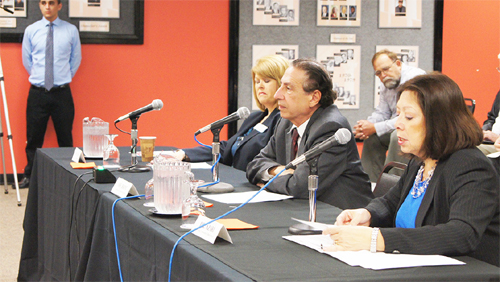
Riverside Community College Interim Chancellor Dr. Cynthia Azari testifies at the US House Committee on Veterans’ Affairs Subcommittee on Economic Opportunity convened by Congressman Mark Takano at RCC earlier this week. Azari testified that the Riverside Community College District has successfully designed a veterans services program that includes a counseling and educational guidance center, veteran-specific orientation sessions and priority registration, and a disabled veterans’ services program.“I found myself going from shelter to shelter in order to have a restful nights sleep, well somewhat of a restful night of sleep,” Travis reflects. “It was harsh. I felt alone and the country I fought to serve and protect was rejecting me.”
It’s estimated that in 2006, nearly half a million U.S. veterans, spent some time homeless. And according to the National Alliance to End Homelessness, homeless veterans on average are younger than the total veteran population with approximately 9% between the ages of 18 and 30. One in four homeless are veterans.
Local elected officials are aggressively tackling this issue by authoring legislation to assist veterans not only in the area of housing but jobs, education, and CalWORKS benefits to aid the men and women who valiantly fought for this country to ease the transition back into civilian life.
 Last month, California Governor Jerry Brown signed into law the Veterans Housing and Homeless Prevention Bond Act of 2014 (AB 639) authored by Speaker John A. Pérez (D-Los Angeles). AB 639 allows California voters in June 2014 the opportunity to repurpose already existing veteran housing funds, nearly $600 million, for better housing options for today’s diverse and expanding veteran populations and their families. More than $1 billion of voter-approved funding has been set aside for single-family homes and farms, while the need for multifamily, transitional and supportive housing has greatly increased.
“I am proud of the actions that the Governor and the Legislature have taken this year to tackle veterans’ homelessness in our state,” Speaker Pérez said in a media statement. “Veterans have devoted their lives to the protection of our country and it is absolutely unacceptable when they cannot afford a place for them and their families to sleep. As citizens, it is our basic obligation to stand up for these men and women who have served our nation, and I look forward to seeing California voters approve this measure.”
California has the largest veteran population in the US, with almost two million veterans calling the Golden State home—a number that is expected to rise by over 200,000 when the wars in Afghanistan and Iraq wind down. California also has more homeless veterans than any other state. Both Riverside and San Bernardino counties rank in the top 10 counties by veteran population in the country.
“Every year in California more than 32,000 veterans suffer deteriorating health, repeated incarceration, and worsening mental conditions because they are homeless,” said Sharon Rapport, Corporation for Supportive Housing Associate Director for California Policy. “They cost our state and local governments almost $3,000 a month in response to repeated crises. Using existing bond authority to create over 10,000 affordable places to live, AB 639 will leverage $3 billion in private and federal funds, will make a crucial commitment to move chronically homeless veterans into housing with services—supportive housing—and will save the lives of veterans now struggling to survive life on the street,” she said.
Housing is not the only issue legislators are tackling. Education is also a top priority that is gaining bipartisan support. Ranking Member of the House Veterans’ Affairs Economic Opportunity Subcommittee Congressman Mark Takano (D-Riverside) recently received a nod from his colleagues on the unanimous passage of the Veterans Economic Opportunity Act of 2013 (H.R. 2481) included in the Act was H.R. 331, which Rep. Takano joined Rep. Ken Calvert (R-Corona) to introduce in January.
The legislation will help decrease education benefit processing times by eliminating unnecessary and duplicative paperwork for individual community colleges that are part of a group, district, or consortium.
Rep. Takano said of the passage of H.R. 331, “With Riverside Community College District campuses in both of our congressional districts, and with Riverside county having the eighth largest veterans’ population in the country, I’m proud that Representative Calvert and I joined forces to make it easier for veterans to receive their veteran education benefits.”
“Our legislation will help decrease education benefit processing times by eliminating unnecessary and duplicative paperwork for individual community colleges that are part of a group, district, or consortium. Specifically, it will allow a multi-college system, such as the Riverside Community College District to verify a student’s class enrollment number with the Department of Veterans Affairs, instead of requiring each individual constituent college to do so.”
Rep. Calvert agrees, “Our veterans deserve a simple, straightforward education benefits process that is free of unnecessary, bureaucratic delays. I appreciate the strong, bipartisan support shown by my House colleagues and I look forward to our continued work to simplify VA benefits for veterans and our colleges. I am hopeful the Senate will act soon on this important legislation and our veterans can start to benefit from a more efficient process.”
Adequate healthcare for veterans is also on the legislative agenda for inland lawmakers. Last week veterans were given a boost in benefit claims as the House of Representatives passed legislation that included a provision authored by Congresswoman Gloria Negrete McLeod (CA-35), HR 1623, the Veterans Administration (VA) Claims Efficiency Through Information Act of 2013.
Inland Empire resident and Tuskegee Airmen Archives co-founder Col. Ralph W. Smith contends the real problem with the federal healthcare system is government. “They have [the government] cut down federal employees and slowed down the whole thing. This is the problem. They have sucked this government up so bad that they have slowed down the process. You go down to the VA and sit or stand in line for 20-30 minutes.”
McLeod’s provision would require the VA to track the time spent evaluating each medical condition in a disability compensation claim. The VA would then have to report the number of completed claims by region and by medical condition for the current and preceding month and year. With this information, Congress and the VA would direct resources more effectively to specific regional VA offices across the nation struggling to end the claims backlog.
“As Veterans Day approaches, we must not forget those veterans who are struggling to find work while living with a service-connected disability,” said Negrete McLeod. “The VA’s legacy paper system has made it difficult to process claims of older veterans who need additional compensation later in life. Claims of younger veterans can also take longer to process because they have multiple medical conditions. The passage of this legislation in the House is an important step towards resolving the backlog of benefit claims in the VA.”
Travis, the former serviceman, is employed as a HAZMAT worker and is no longer homeless. He is excited by the passage of the new legislation. “It took me a while to get back on my feet,” he says, “but hopefully other vets won’t have to go through what I’ve been through. It was rough. But thank God he saw me through. And with this new legislation, other veterans will have a fighting chance after fighting for this country.”