



By Marta M. Brown
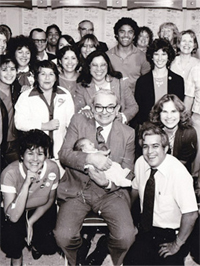
Last week, I was honored to stand up for my late husband George Brown. He was inducted into the hall of fame of leaders from our Inland Region who stood up strongly for civil rights and communities free from pollution.
This Sunday, dozens of people will come together in Riverside along with legendary actor Ed Asner to honor him, a fighter for communities of color, for women, for equal rights, education, and a cleaner environment.
The struggles for justice that defined George Brown’s public service did not fade away with him. In addition to myself and my sister Gloria Macias Harrison, a member of the San Bernardino Community College District (SBCCD) board of trustees, he leaves behind a generation of leaders in our community still fighting for the common good, environmental health, and respect and empowerment for people of modest means.
In tribute to his commitment to the environment and ethical public service, both the federal courthouse and salinity laboratory in Riverside bear his name.
George’s devotion to ending discrimination and people’s exposure to pollution began during his childhood, part of which he spent in Redlands. He went on to represent parts of San Bernardino and Riverside counties in Congress from 1973 to 1999. His core values of dignity and autonomy for all people, a livable and sustainable planet, and problem-solving through science and cooperation, not violence, meant a lot more to him than politics or policy goals. He also lived them.
George lived and led the way for California through four decades defined by the civil-rights revolution, the emergence of the farm-workers movement, the blossoming of environmental action and the first Earth Day, the women’s movement, the lesbian and gay rights movement, the Native American movement, and the rise of immigrant, disability, and online activism. George took all these movements very seriously, and included well-qualified advocates from all of them on his staff. As a peace activist and war veteran himself, George welcomed and integrated people of different beliefs and backgrounds into public service.
Last week, I was honored to stand up for my late husband George Brown. He was inducted into the hall of fame of leaders from our Inland Region who stood up strongly for civil rights and communities free from pollution.
This Sunday, dozens of people will come together in Riverside along with legendary actor Ed Asner to honor him, a fighter for communities of color, for women, for equal rights, education, and a cleaner environment.
The struggles for justice that defined George Brown’s public service did not fade away with him. In addition to myself and my sister Gloria Macias Harrison, a member of the San Bernardino Community College District (SBCCD) board of trustees, he leaves behind a generation of leaders in our community still fighting for the common good, environmental health, and respect and empowerment for people of modest means.
In tribute to his commitment to the environment and ethical public service, both the federal courthouse and salinity laboratory in Riverside bear his name.
George’s devotion to ending discrimination and people’s exposure to pollution began during his childhood, part of which he spent in Redlands. He went on to represent parts of San Bernardino and Riverside counties in Congress from 1973 to 1999. His core values of dignity and autonomy for all people, a livable and sustainable planet, and problem-solving through science and cooperation, not violence, meant a lot more to him than politics or policy goals. He also lived them.
George lived and led the way for California through four decades defined by the civil-rights revolution, the emergence of the farm-workers movement, the blossoming of environmental action and the first Earth Day, the women’s movement, the lesbian and gay rights movement, the Native American movement, and the rise of immigrant, disability, and online activism. George took all these movements very seriously, and included well-qualified advocates from all of them on his staff. As a peace activist and war veteran himself, George welcomedMore than two hundred people worked on George’s staff over the years, including SBCCD board member John Longville and former Assemblymember Wilmer Amina Carter. As Longville likes to say, literally hundreds of people trace their beginning in public service to mentoring, encouragement, and challenges posed to them by George Brown.
This year, a new generation of students in our community has begun to discover the importance and impact of George Brown’s public service. George Brown Elementary is among the newest of San Bernardino public schools. George passed away 14 years ago. He would be deeply touched that a beautiful new school run be devoted educators incorporating Spanish and English in their curricula now provides a ladder of learning for local students and bears his name.
The George Brown Legacy Project is the nonprofit organization dedicated to preserving the records and celebrating the recipe for leadership of my late husband. We are working to complete his archives at UC, Riverside. Please join me this Sunday afternoon, Nov. 24, along with a united community in support of his legacy for a celebration and fund-raiser to open his archives:
Sunday, November 24, 2012
2 to 4 p.m.
8710 Windmill Place
Riverside, CA 92508
Ample free parking at venue
Requested $100 contribution. All donations welcome and tax-deductible.
For more information, please call project director Hans Johnson at 323-669-9999 or write hansj@progressivevictory.com or visit http://library.ucr.edu/view/georgebrown.