



Prince James Story
In May, California Attorney General Bonta announced that the U.S. Court of Appeals for the Second Circuit approved OxyContin manufacturer Purdue Pharma’s bankruptcy reorganization plan.
California is expected to receive $486 million of the $6 billion settlement to fund opioid addiction treatment and prevention programs.
“The opioid crisis has left a trail of pain, grief, and destruction across the nation that will leave its mark on generations to come. Its ringleaders — Purdue Pharma and the Sackler family — bear responsibility for causing much of this grief,” Attorney General Bonta said in a press release.
Bonta hopes that the funds awarded from the settlement can be utilized to heal communities. While Purdue Pharma faces the consequences, the Sackler family, who privately owned Purdue, are shielded from such consequences and financial responsibility.
Some key takeaways mentioned in the settlement are that the payments will be spread out over 18 years. In addition, institutions can remove the Sackley family name from buildings, scholarships, and fellowships.
In 2021, Bonta announced a $26 billion settlement with three major pharmaceutical distributors: Cardinal Health, McKesson and AmerisourceBergen, it included Johnson & Johnson, a company that manufactured and marketed opioids.
California is expected to receive $2.05 billion from this settlement, and payments will continue until 2038. The money will be used for opioid remediation.
In early June, a few more opioid settlements were announced with Opioid manufacturers Allergan and Tegra. Settlements with pharmaceutical companies CVS and Walgreens were also attained.
California stands to gain up to $375 million from the Teva settlement and up to $205 million from the Allergan settlement, $470 million from the CVS settlement, and another $510 million from the Walgreens settlement.
Data from the U.S. Centers for Disease Control and Prevention (CDC) indicate that in 2021 there were over 80,000 overdose fatalities involving opioids in the United States. In California there was close to 6,000 opioid overdoses.
In 2021, there were a total of 10,901 fatal overdoses in California.
Prescription opioids are not the primary cause of overdoses in Riverside County, according to Wendy Hetherington, the branch chief of epidemiology & program evaluation for Riverside University Health System. Hetherington is also the principal investigator for the Riverside Overdose Data to Action (RODA) program.
Numbers tell the story
RODA partners with the Emergency Management Services Agency in Riverside County, the Sheriff’s Office, probation offices, and behavioral health programs to gather data in order to understand the scope of the opioid crisis in the region.
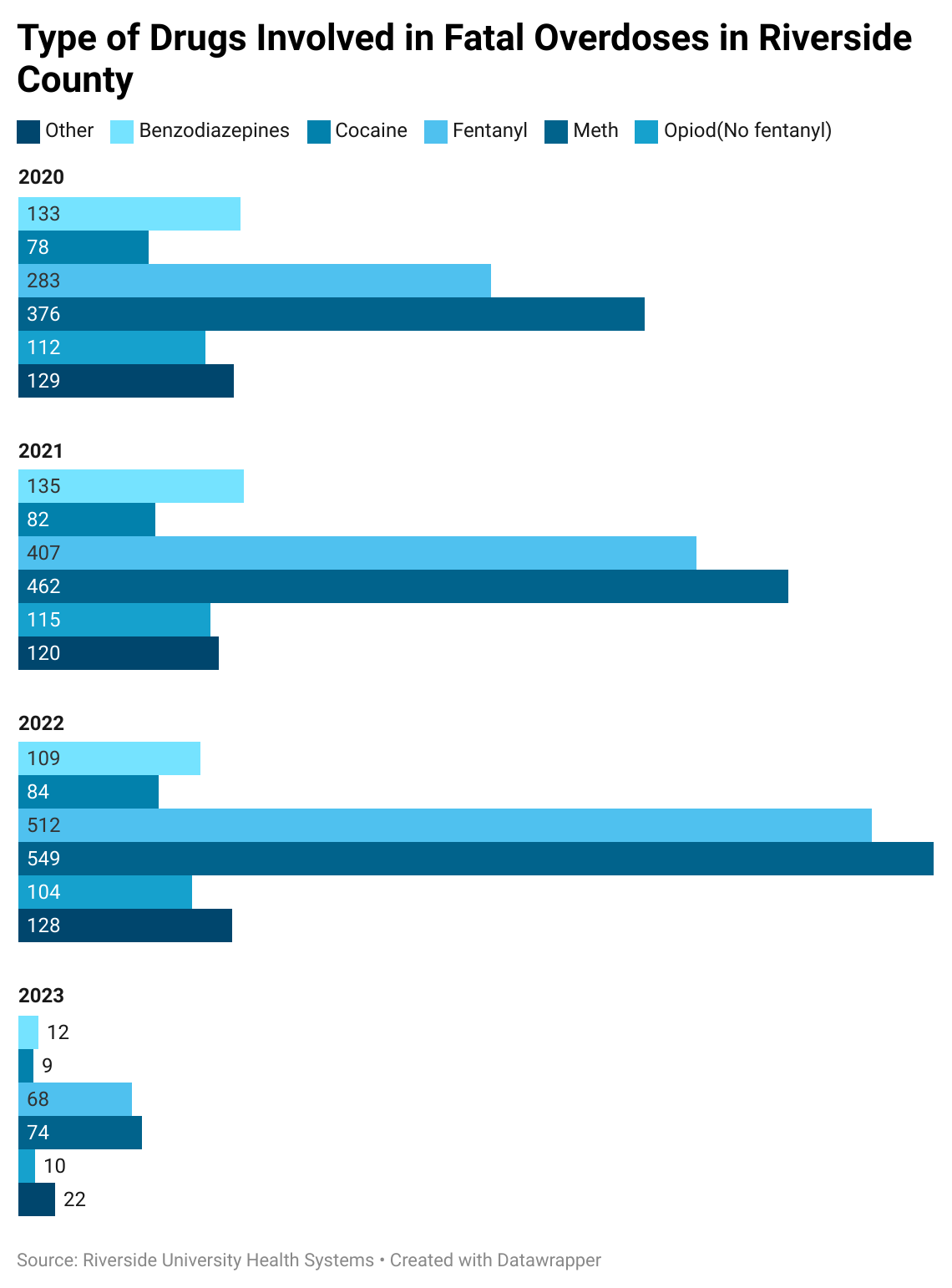
“I will say right now 80% of our overdose deaths involve fentanyl and/or methamphetamine,” Hetherington said.
“There are more overdoses that involve the combination of both fentanyl and methamphetamine than there are overdoses with fentanyl on its own or methamphetamine on its own.”
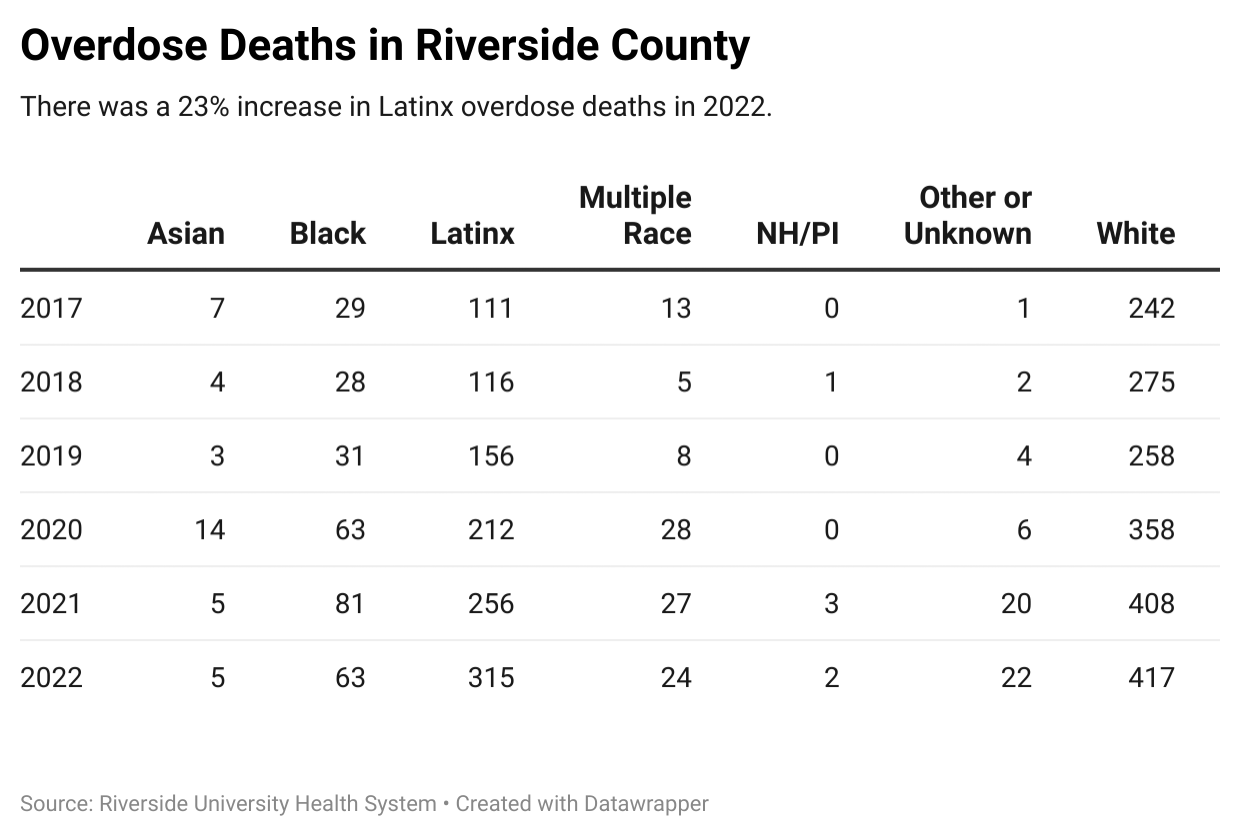
In 2021, there was an increase in overdoses in the Black population which decreased in 2022.
The Latinx population has experienced a steady increase in overdose fatalities, which is concerning, Hetherington noted.
Hetherington cited demographics where there has been an increase in overdose fatalities, such as people experiencing homelessness who are considered to be a high-risk group during the drug crisis. Twenty-five percent of people who overdose are unhoused.
Adults over 35 make up approximately three out of four overdoses in the county. Preliminary data showed that five overdoses occurred in people under 18 in 2022. According to RODA’s latest count, there were 859 overdose deaths in Riverside County in 2022.
Seeking solutions
One solution to addressing the drug crisis in Riverside County is eliminating the stigma around those suffering from drug abuse and focusing on decriminalizing those addicted to drugs.
“We know from years and years of working on this issue in the United States that the war on drugs hasn’t been successful, and continuing down this path is not going to prevent more overdoses unless you’re truly addressing the root causes about why people become addicted in the first place,” Hetherington said.
Dr. Andrew Subica, a health disparities researcher and associate professor of social medicine at the University of California, Riverside, discussed bringing more harm reduction programs to the Inland Empire.
Harm reduction services are considered controversial because they include safe injection sites. They also provide syringe and naloxone distribution services. Data shows that harm reduction services help prevent overdose deaths and the transmission of infectious diseases.

“Harm reduction tries to meet people where they’re at and then minimize the negative health impacts on their lives,” Subica said.
“It does, over time, allow people to build a connection. Then, that’s where you can eventually try and get them resources, including employment and get them health care because people who use substances often have a lot of mental or physical health problems.”
After the connection is made, there is an opportunity to enroll those struggling with drug addiction into detox programs, but the key is to avoid pushing them into abstinence because then “you might lose them,” Subica emphasized.
Riverside needs programs that protect the health of everyone who suffers from drug abuse because there has been an upward trend in overdoses of methamphetamines for twelve years. It is trending toward thirteen years by the time 2023 ends.
Fatal fentanyl overdoses have also been trending upward for the last few years.
With the state’s funding from these settlements, harm reduction advocates and researchers hope the money will be put to good use to prevent the loss of more lives.