


S. E. Williams
For those who followed the breaking news about Amazon’s leaked memo and then took time to read it got a real glimpse into the conniving that goes on behind the scenes in major corporations.
I’m sure their cunningness is not unique. In fact, having spent years on a vice-president’s staff for another major corporation in my previous life I might even venture to say it is probably pretty common.
In this instance, however, it struck me as particularly sleazy for a number of reasons beginning with this statement from the memo that feigns concern for public health.
“Enhance Amazon’s reputation in the health arena as Amazon Health plans to scale in California, proactively supporting PP and connecting our health teams to our CE grantees in the same or adjacent space, such as DAP Health and San Ysidro Health.”
Meanwhile, the area is designated a ‘diesel death zone’ by physicians due to high rates of asthma, cancer and respiratory illnesses associated with ozone and air pollution.
Or, in another example where Amazon seeks to promote their concern for the environment: “Positively affect legislative attempts to ban Single Use Plastic by showcasing Amazon as a leader in sustainability and counter the voices of environmental activists against Amazon. We will highlight our Climate Pledge, renewable battery investments in SoCal, new electric trucks at the Port of LA, the sustainable story around drone deliveries.”
Meanwhile, speaking of the environment, San Bernardino and Riverside Counties continue to rank first and second respectively for the worst ozone pollution in the United States. And both counties also have the dubious honor of also ranking as the worst in annual particle pollution nationally, according to the 2022 State of the Air Report by the American Lung Association.
Don’t get me wrong, Amazon did make references to “air” at least four times in its secret memo but it had nothing to do with concerns over the region’s air quality or the health implications resulting from it. As with any corporate sociopath all the references to air were in relation to itself…and its “air” hub.
Amazon touted how it would leverage its philanthropic efforts to develop third party advocates and coalitions. They must view this as a really great idea, because it’s mentioned twice in the document.
“Bolster third party advocates to support our Southern California legislative agenda. For example, develop five go-to community partners that I can call on to rally behind any priorities. Will do this by focusing on these relationships, and cultivating deep trust and friendship…” through partnership and sponsorship efforts.” In this regard I think it is important that we keep in mind that all money is not good money.
Next, as we enter an election year, I think it is important that the community also take heed to Amazon’s desire to gain more political control. Maybe we should consider a litmus test for candidates at the local and state levels next year, like asking their positions on building more warehouses in the region. I highlight this because one of the key strategies noted in the leaked document states, “There are currently not enough Amazonians serving on prominent boards in Southern California.”
Another point in the document I found interesting was their clarity about the types of groups they will not support with donations, etc. Who would think they would single out something as important to community culture as an art gallery?
It’s true. Here is what Amazon said, “We will not continue to support organizations that did not result in measurable positive impact on our brand and reputation. Additionally, we will not fund organizations that have positioned themselves antagonistically toward our interests. For example, in 2022 and 2023 we donated to The Cheech Marin Center for Chicano Art & Culture in Riverside. In 2023, the Cheech Center exhibited a local artist who depicted an Amazon facility on fire, and the artist then gave an interview expressing hostility towards Amazon. We will not donate to The Cheech.”
It seems like a petty, vindictive form of retaliation. But, it is a striking warning to other nonprofits in the area who could benefit from their support. It is basically telling everyone, “Keep your mouth shut or go somewhere else for funding.”
I applaud The Cheech for its courage and for not compromising its integrity. It seems there are others, including taxpayer funded museums that want to stay as far away from anything that could be perceived as critical of the warehousing giant.
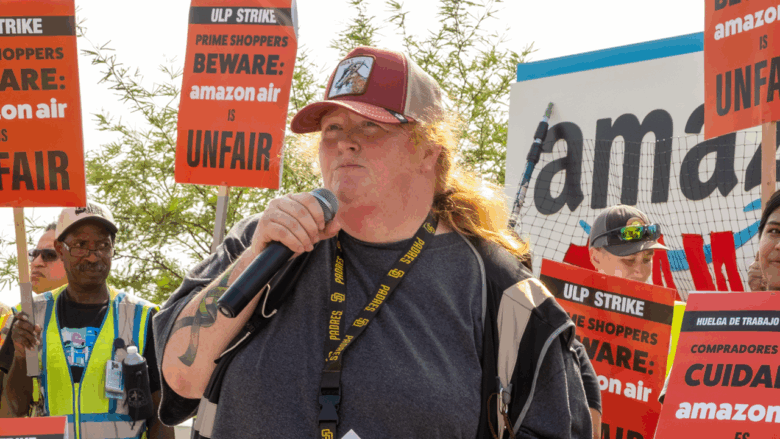
One thing this memo affirmed for me is that despite its protestations–it appears Amazon may retaliate after all. I say this because in January we reported on an Amazon worker, Sara Fee, who claimed she was put on paid suspension and investigated by Amazon for organizing in support of workers’ rights. She was also surveilled and targeted by Amazon union busters, officially known as labor and employee relations consultants.
We reached out to Amazon for their version of the story and they eventually responded claiming the charges were without merit. In other words, the employee’s suspension was not retaliation. They claimed Fee, “acted in an unprofessional and inappropriate manner that violated our standards of conduct. She was temporarily suspended with pay, and has returned to work.”
We printed their response, but that was not enough. They tried to pressure the reporter and later myself.
We refused to acquiesce to their request to change the story.
In the beginning of my communications with Amazon on this issue they claimed they were excited to establish a relationship Black Voice News, encouraged us to reach out at any time and even offered to give our photojournalist a tour. Of course, the discussion regarding the article ended on professional terms. However, months later when I called to arrange a tour for our photojournalist–we were denied…. Was that retaliation? I’m sure you know what I think.
Of course this is just my opinion. I’m keeping it real.